Lucknow,
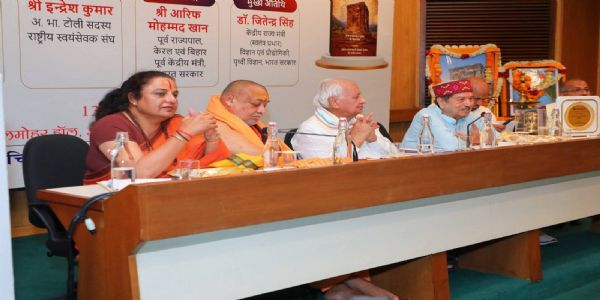
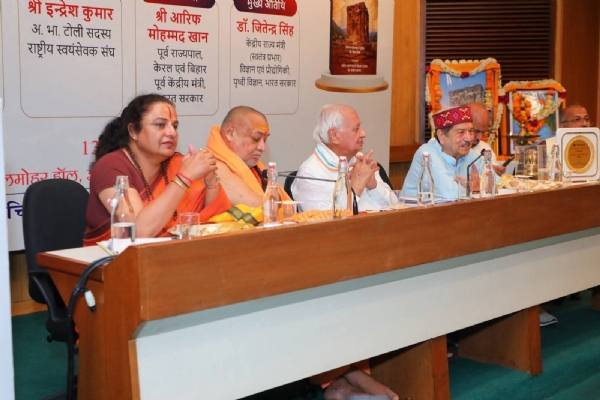
14 May (HS): A distinguished book launch ceremony for “Sharda Peeth: First
Wisdom University of the World”—a scholarly work exploring India’s ancient
knowledge systems, Sharda civilization, and cultural heritage—was held at the Gulmohar
Hall, India Habitat Centre. The event brought together eminent saints,
scholars, academicians, writers, social thinkers, and distinguished guests from
across the country. The book, authored by noted scholar-researchers Khwaja
Farooq Renzushah and Prof. Geeta Singh, has been published by Suruchi
Prakashan, a publishing house engaged for over five decades in works related to
India’s civilizational, cultural, and intellectual traditions.
Sharda
Peeth as a Civilizational Symbol: In her address, Prof. Geeta Singh highlighted
Sharda Peeth, believed to have been established nearly 2500 years ago in
present-day Pakistan-occupied Kashmir, as one of the earliest global centers of
learning. She described it as a “temple of knowledge” that nurtured Sanskrit,
philosophy, and grammar, and played a crucial role in shaping the intellectual
landscape of North India. She further noted that the Sharda script emerged from
this tradition and remained a key medium of knowledge transmission for centuries.
Referring to ancient institutions such as Takshashila, Nalanda, and Sharda
Peeth, she called them enduring pillars of India’s spiritual and intellectual
heritage. Quoting
the vision of the Prime Minister of India, Narendra Modi, she emphasized the need
to revive India’s cultural and intellectual traditions, stating that the
present book serves as an important contribution toward that mission.
Kashmir
as Land of Spiritual Knowledge: Co-author Khwaja Renzushah described Kashmir as
a historic land of sages and spiritual masters. He referred to great
philosophers such as Nagarjuna, Vasugupta, and Abhinavagupta, who enriched its
intellectual heritage. He remarked that while invaders such as Alexander passed
through history, the civilizational essence of Kashmir has remained timeless
and resilient.
Keynote
Address: Ethics, Dharma, and Civilizational Thought - Delivering the keynote address, former
Governor and Union Minister Arif Mohammad Khan drew upon the Mahabharata’s Vana
Parva, citing the dialogue between Yudhishthira and the Yaksha. He recited the
well-known verse: “तर्कोऽप्रतिष्ठःश्रुतयोविभिन्ना, नासावृषिर्यस्यमतंनभिन्नम्।
धर्मस्यतत्त्वंनिहितंगुहायां, महाजनोयेनगतःसपन्थाः॥”
He
explained that ultimate truth cannot be established solely through logic or
singular scriptural authority. Instead, he emphasized that dharma is deeply
rooted in ethical conduct and collective wisdom, and the path followed by
virtuous and responsible individuals in society serves as a guiding principle.
He
also reflected on the influence of Swami Ranganathananda and his work Eternal
Values for a Changing Society, stating that knowledge must not only be acquired
but also shared. He further referenced the philosophical insights of
Rabindranath Tagore and Francis Bacon, concluding his address with the
universal prayer, “May all be happy.”
Knowledge,
Courage, and Character Building: Indresh Kumar stressed that education must go
beyond information and foster courage, discipline, and moral strength.
Recalling his experiences in Jammu and Kashmir, he remarked that cultural
traditions such as Sharda heritage instill fearlessness and resolve. The
audience resonated with chants of “Jai Saraswati, Jai Bharat.”
Sanatan
Dharma and Civilizational Identity: Swami Rajrajeshwarashram Ji Maharaj stated
that Sanatan Dharma is eternal, beyond temporal classifications of new or old.
He described religion as the foundational essence of Indian civilization and
urged a philosophical rethinking of constitutional terminology, advocating the
replacement of the term “secular” with a more culturally rooted expression.
Publication
Vision and Closing Remarks: Rajiv Tuli described the publication as inspired by
cultural and ideological commitment, stating that Kashmir remains a shared
civilizational heritage. The event concluded with a vote of thanks delivered by
Rajneesh Mittal. In the welcome address, organizers emphasized that the book is
not merely a historical account but a scholarly attempt to revive India’s
intellectual consciousness and cultural identity. Scholars and attendees widely
appreciated its academic depth and relevance, particularly for researchers,
students, and readers engaged with Indian philosophy, civilization, and
heritage studies.
Hindusthan Samachar / Abhishek Awasthi

14 May 2026