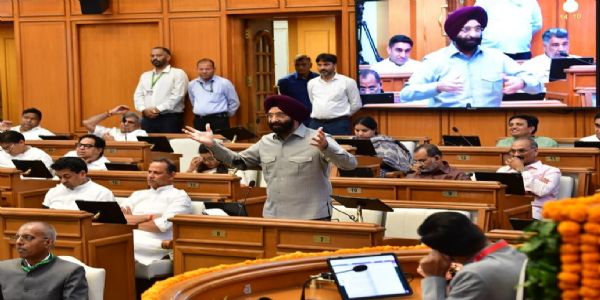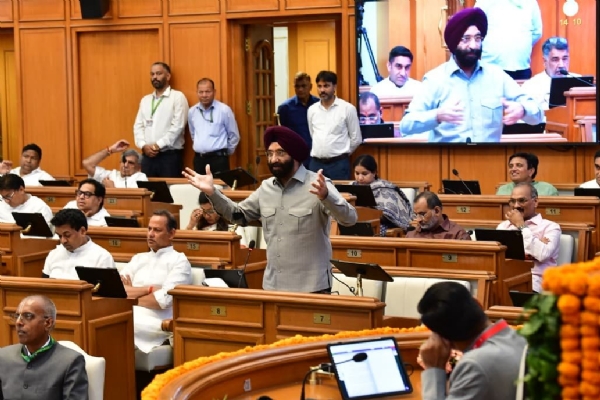
New Delhi, 28 April (H.S.): Addressing a special session of the Delhi Legislative Assembly today, Environment Minister Manjinder Singh Sirsa strongly condemned Opposition parties for blocking the Nari Shakti Vandan Adhiniyam (Women’s Reservation Bill), describing it as a historic attempt to secure the constitutional rights of half the country’s population. Under the proposed law, women were to be guaranteed 33 per cent representation in the Lok Sabha, Rajya Sabha, state legislative assemblies and councils, but Sirsa alleged that the Congress, AAP, SP, DMK and other Opposition parties colluded to sabotage this landmark opportunity.
“A historic step for women’s political empowerment”
Sirsa argued that the bill was not merely about numbers but about making Indian democracy more inclusive and reflective of its demographic reality. He highlighted that with Prime Minister Narendra Modi at the helm, the Central government had consistently pursued measures to politically empower women, including 50 per cent reservation in panchayats, which has enabled hundreds of thousands of women to participate in decision‑making and leadership roles in education, health and social development.
“That model of women’s participation in local governance is the world’s largest exercise of democratic women’s empowerment,” he said, framing the stalled national‑level bill as a natural extension of the same logic.
Opposition tactics and “betrayal of half the population”
The minister recalled that the idea of a 33 per cent reservation for women had been pushed repeatedly since 1996, with Atal Bihari Vajpayee’s governments attempting to introduce it four times in Parliament, only to be frustrated by Opposition resistance. When the legislation finally cleared the Rajya Sabha in 2010, public hope surged, but the Congress‑led coalition, in alliance with its allies, prevented it from reaching the Lok Sabha, according to Sirsa.
He reiterated that the 2023‑era version of the 131st Constitutional Amendment Bill—to be implemented via the Nari Shakti Vandan Adhiniyam—would have ensured over 200 women MPs in the Lok Sabha alone and a new chapter of women’s leadership across the country. Sirsa accused the Opposition of acting out of “doubt, delay and narrow political interest” rather than principle, and warned that “history will not forgive those who played politics with women’s rights, and the daughters and sisters of this country will never forgive them.”
Defending delimitation and broader BJP record
On the sensitive issue of delimitation, Sirsa rejected the Opposition’s narrative that it would disadvantage certain states, insisting that adjusting seat‑allocations to reflect updated population figures is a constitutional necessity to ensure equal strength for every citizen’s vote. He stressed that the goal is not to favour any region but to maintain fair representation across the federation as India’s population has grown from about 50 crore to nearly 140 crore.
Sirsa also cited the BJP’s own record of empowering women leaders such as Sushma Swaraj, Uma Bharti, Vasundhara Raje, Anandiben Patel, President Droupadi Murmu and Chief Minister Rekha Gupta, arguing that the party has not merely spoken of equality but actually placed women in the highest echelons of power.
Historical and cultural framing of women’s rights
Linking the current debate to India’s social and cultural ethos, Sirsa recalled that Sikh religious bodies in Punjab pioneered women’s voting rights as early as the 1920s under the SGPC Act, well before wider national recognition. Quoting Guru Nanak Dev’s line—“So kyon maanda aakhiae, jit janme raajan”—he emphasised that Indian thought has long repudiated the notion that women are inherently inferior.
He concluded by insisting that “respect for women is not proven through speeches but through decisions” and warned that if the bill had passed unobstructed, the country’s law‑ and policy‑making would have become significantly more inclusive, with women in decision‑making roles from Parliament down to every state legislature.
Sirsa’s remarks, delivered in the Delhi Assembly on the heels of the bill’s collapse in the Lok Sabha, underscore the BJP’s bid to turn the women’s reservation issue into a central plank of its political‑mobilisation strategy ahead of the 2029 national elections.
---------------
Hindusthan Samachar / Jun Sarkar