New Delhi, 01 April (H.S.):
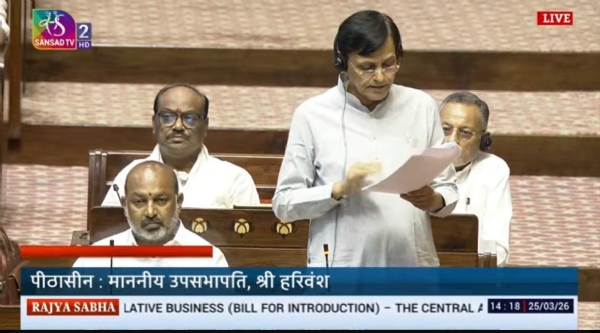
The Central Armed Police Forces (CAPF) (General Administration) Bill, 2026 has been passed by the Rajya Sabha through a voice vote, even as the Opposition staged a walkout following protests and noisy sloganeering over the measure. Home Minister of State Nityanand Rai, while replying to the debate, said the Bill’s primary objective is to enhance the operational efficiency and morale of the CAPF by providing a clear, unified framework for service‑condition and appointment rules.
Government’s Rationale and Key Features
Nityanand Rai said the scope of the CAPF has been expanding continuously, and structural and administrative constraints had begun to show. The Bill, he added, is “command‑based” and seeks to streamline the system where appointments are made on deputation, especially for senior posts, by giving it a clear statutory framework.
He argued that the provisions are designed to ensure continuity of financial benefits for serving officers and that the Bill would strengthen the federal structure by aligning CAPF governance with broader national‑security requirements. The Minister noted that Group‑A CAPF officers would continue to receive four promotion tiers within the existing career ladder.
Key Reservation Provisions
Under the new law, 50 per cent of posts at the Inspector General (IG) level and at least 67 per cent of Additional Director General (ADG) posts in the CAPF will remain reserved for Indian Police Service (IPS) officers on deputation. The positions of Special Director General (SDG) and Director General (DG) are to be filled exclusively by IPS officers.
Supporters say the Bill codifies an existing practice of deputation but under a single, overarching statute and replaces the current patchwork of separate service‑rule regimes for the five major CAPFs—CRPF, BSF, CISF, ITBP and SSB.
Opposition Criticism and Walkout
The debate turned stormy after Aam Aadmi Party MP Saket Gokhale flagged concerns about service conditions, arguing that similarly ranked CAPF officers have far fewer facilities and perks than their IPS counterparts despite being on the front lines. He also alleged that the Centre was using IPS leadership in the CAPF to deepen political control over these forces rather than allowing internal cadre officers to rise.
Congress‑led Opposition members contended that the legislation undermines constitutional values and the principle of natural justice, and demanded that the Bill be referred to a select or joint committee for detailed scrutiny.
Senior Opposition leader Mallikarjun Kharge said several members had sought more time and in‑depth examination of the Bill but were ignored.
In the ensuing noise and disruptions, the Opposition walked out of the House in protest.
Union leader of the House J.P. Nadda criticised the move, saying the Opposition has shown little interest in parliamentary discussion and has repeatedly refused to engage in substantive debate. He described the walkout as evidence that the Opposition does not respect parliamentary procedure.
Earlier Debate and Path Ahead
The Bill had already been discussed in the Rajya Sabha on 30 March 2026, when the Opposition similarly objected to the codification of IPS dominance in senior CAPF slots and asked for committee referral. The Bill is now expected to be taken up in the Lok Sabha on Thursday for consideration and passing, where it is likely to trigger another round of heated exchanges over the balance between national‑security management and the rights and career progression of CAPF officers.
---------------
Hindusthan Samachar / Jun Sarkar