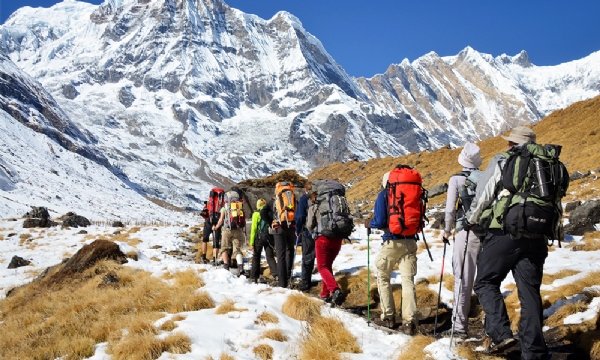
Kathmandu, 09 February (H.S.): Over the past two-and-a-half decades, a staggering 2,632,034 foreign tourists have flocked to the world-renowned trekking hub of the Annapurna region in north-central Nepal's Gandaki Province.
Annapurna I, the crowning summit of the Annapurna massif, soars to 8,091 meters (26,545 feet), securing its position as the world's 10th highest mountain. This majestic peak is encircled by the Kali Gandaki gorge to the west, the Marsyangdi River to the north and east, and the Pokhara Valley to the south, creating a dramatic Himalayan amphitheater.
The Annapurna Conservation Area Project (ACAP) released these figures on February 9, 2026, highlighting arrivals starting at 65,313 in 2001 and surging to a record 299,831 in 2025—the highest ever recorded.
Numbers dipped to a mere 16,105 in 2021 amid the COVID-19 pandemic's grip, while staying below 100,000 annually from 2001 to 2010.
Visitor counts first exceeded 100,000 in 2011 during Nepal's Visit Nepal Year, reaching 101,908, only to plummet to 78,930 post the 2015 Gorkha earthquake.
Recovery accelerated from 2022, with 129,723 arrivals that year, followed by 191,558 in 2023 and 244,039 in 2024.2025 Breakdown and InsightsIn 2025, South Asian nations contributed 177,628 tourists, while 122,203 hailed from other countries, drawing trekkers, adventure seekers, and pilgrims alike, according to ACAP Chief Dr. Rabin Kadariya.
He noted the sustained upward trajectory in tourism to this biodiversity-rich zone.
Prime AttractionsIconic spots along the Annapurna Circuit include Annapurna Base Camp, Mardi Himal, Ghandruk, Tilicho Lake, Thorong La Pass, Upper Mustang, Muktinath, and Ghorepani, captivating visitors with pristine nature and cultural heritage.
Spanning 7,600 square kilometers—Nepal's largest protected zone—ACAP tracks only foreign visitors, celebrating the region's unparalleled natural splendor, ethnic diversity, and alpine lifestyles.
---------------
Hindusthan Samachar / Jun Sarkar