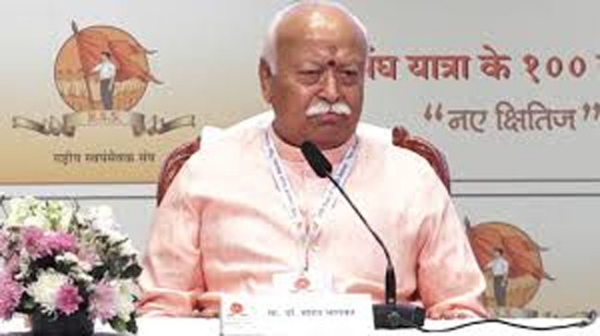
Mumbai, February 08 (HS): Rashtriya Swayamsevak Sangh (RSS) Chief Dr. Mohan Bhagwat said on Sunday in Mumbai that those who try to break India will themselves be broken; this is not the India of 1947. He said that one should envision the rise of an undivided India by 2047.
Addressing the first session on the second day of the “Naye Kshitij” programme held in Mumbai to mark the completion of 100 years of the RSS, Dr. Bhagwat said that hooliganism is never the fault of an entire society. Social vigilance helps in controlling disruptive activities.
The RSS Chief reiterated that one should imagine the emergence of an undivided India in 2047. Those who seek to divide India will be broken; this is not the India of 1947. He said that there is a blood bond with the Sikh community, and a relationship of shared bread and marriage. Marital ties exist between Keshdhari and Sahajdhari Sikhs. The Guru Granth Sahib contains the verses not only of Sikh saints but of saints from across the country. Referring to Hindu–Sikh unity as two separate entities is incorrect; it may appear so, but in reality we are all one.
He said the Sangh supports all constitutionally valid reservations. All causes of caste-based discrimination must be completely eliminated. Referring to a book based on a speech by the third Sarsanghchalak, Balasaheb Deoras, at the Vasant Mahotsav—Samajik Samarasata aur Hindutva—he said the Sangh’s position is clear. Its role on caste discrimination is firm and explicit. If brothers who suffered inequality for 2,000 years require society to bear some adjustment for 200 years, that too is a very small price. Those working in politics are neither deeply casteist nor deeply egalitarian; they are vote-centric. When complete social harmony is established, caste-based politics will end. Caste as a system no longer exists; it is now a disorder. Casteist sentiment is receding and will continue to do so; efforts should be made so that it fades away naturally.
Dr. Bhagwat said the Sangh is against corruption and in favour of probity. A person with good values will not indulge in corruption. Quoting Chanakya—“One cannot tell when a fish drinks water”—he said it is similarly difficult to detect when and how corruption occurs. Therefore, corruption cannot be eliminated merely through laws and punishment; it can be eradicated only through values and upbringing. He said doctors note that marriage between the ages of 19 and 25 and having at least three children contributes to overall health. For population balance, having two to one children is necessary; one alone is insufficient. Hence, three children is an ideal situation, according to doctors, sociologists and others. Raising children is not a major issue.
He said marriage is a sacrament and should be upheld with responsibility. He identified two major causes of population imbalance besides birth rate. The first is conversion. Voluntary conversion is not an issue, but conversions carried out through coercion or inducement to increase numbers should stop; “ghar wapsi” is the remedy. The second cause is infiltration. Such people should be sent back. Earlier this did not happen; now it occurs to some extent. While deportation may not be possible, identification certainly is. At the very least, infiltrators should not be given employment.
The RSS Chief said that even with the advent of new technologies like AI, employment opportunities should not be allowed to shrink; thinking and action should follow this principle. It is not right to oppose technology altogether. The dignity of manual labour must increase, which requires a change in mindset. India has a large workforce; an economic system should be developed that provides work to idle hands. An idle mind is the devil’s workshop; this leads to Naxalism, rising violence and atrocities against women. Economic decentralisation is necessary.
He said that organic farming reduces costs. There are many examples across the country where farmers use their own seeds and fertilisers and thus retain ownership of the entire farming process. Farming costs should be reduced. Storage and processing of agricultural produce help farmers secure better prices; this is something the government should do. When costs fall, farmers need not take loans. Dada Lad is a fine example, having been awarded the Padma Shri.
Dr. Bhagwat said initiatives like “One District, One Product” are proving effective for traditional occupations and women’s empowerment. GDP is not an effective measure of a country’s economic condition; it is imperfect. GDP is an inadequate and incomplete metric. Where is the accounting of the labour and production of our mothers and sisters in its calculation? The measurement needs correction.
Several personalities from the film industry and the administrative services were present at the programme, including Ananya Panday, Karan Johar, actor Jackie Shroff, and senior administrative officers Milind Mhaisakar and Manisha Mhaisakar.
---------------
Hindusthan Samachar / Indrani Sarkar
08 Feb 2026