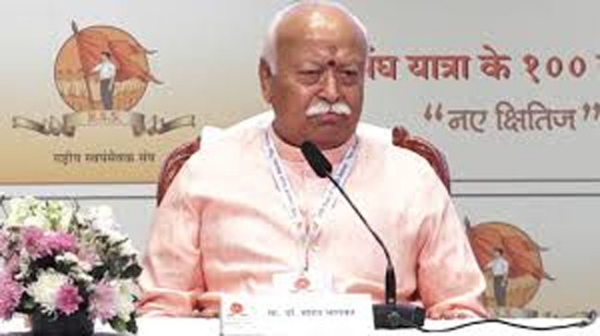
Mumbai, February 08 (HS): Rashtriya Swayamsevak Sangh (RSS) Chief Dr. Mohan Bhagwat on Sunday said in Mumbai that the idea of a Uniform Civil Code (UCC) is good. He said there is no opposition to diversity, and if equality strengthens national unity, the Sangh supports it. He also said that if freedom fighter Vinayak Damodar Savarkar is awarded the Bharat Ratna, it will only enhance the dignity of the honour.
Dr. Bhagwat was addressing the second session on the second day of the “Naye Kshitij” programme organised in Mumbai to mark the completion of 100 years of the RSS. He reiterated that the idea of a Uniform Civil Code is good and that there is no objection to diversity. If equality strengthens the unity of the country, the Sangh supports it, but such efforts should not create a situation of conflict. He cited Uttarakhand as an example, saying the state first proposed the UCC, then sought public feedback and received nearly three lakh suggestions, after which the law was enacted.
However, merely enacting a law is not sufficient; it must also be implemented. Despite this, he said, the Sangh stands for unity in diversity. “We are one society. We should not think in terms of minorities and majorities. If divided, all of us become minorities,” he said.
The RSS Chief said that Lord Buddha also referred to his path as Sanatan Dharma. Hinduism, he said, is not a religion in itself; Sanatan Dharma has two branches—the Vedic tradition and Buddhism. He said the form of Islam seen today is not the Islam of Prophet Mohammed, and present-day Christianity is not the Christianity of Jesus Christ. According to him, both Islam and Christianity have moved away from their spiritual foundations towards political dominance, and there is a need for them to return to their true spiritual essence. He said Hindus must speak of inclusiveness and peace, and be in a position where no one can cause them harm.
He said that in today’s world, no country can remain isolated and international engagements are inevitable, involving both give and take. One must always keep national interests in mind, and he expressed confidence that this is being done at present. Referring to the last ten years, he said the administration has shown firmness and resolve. Knowledge should be acquired from across the world, but only after careful evaluation. Accepting everything merely because it is new, without understanding the nation’s aspirations, traditions and the interests of farmers, is not appropriate; hence, sensitivity is necessary.
Dr. Bhagwat said it is incorrect to say that “good days” began only after the BJP came to power; in fact, the opposite is true. The Sangh stood firmly for the Ram temple, and political forces that supported this position benefited. Other parties did not support it. He said that through struggles such as the Emergency, Guruji’s birth centenary and the Ram temple movement, and with the cooperation of people and the dedicated efforts of volunteers, progress was achieved, the benefits of which went to those who supported the Sangh.
He remarked that the lack of expansion of the Communist Party over 100 years is a question they should answer. If they seek guidance, the Sangh is willing to provide it. Principle-less politics continues because it appears to work; when it stops working, it will be abandoned. He emphasised that Sanskrit should be spoken, as a language survives only if it is in use. He said Gen Z is also realising the importance of identity and asked whether we are prepared to pass on our heritage to the new generation in their language, and whether we ourselves understand the Hindutva we wish to pass on. He noted that the trend of “satsang parties” replacing rave parties was a natural change, not one engineered by the Sangh.
The RSS Chief said there is no law to force people to eat fast food, so why should there be a law to ban it. Fast food spread due to temptation, and self-restraint is the only solution. Not every task needs to be done by the Sangh alone, he said, adding that even with full-time efforts, the task of building a society of strong character remains challenging. He noted that India was among the first to fulfil commitments under the Paris Agreement. Environmental responsibility is not just for the Sangh but for the entire society, though environmental protection is one of the Sangh’s activities.
He said the RSS is an eternally youthful organisation, with an average age of 28 years, which it aims to bring below 25. The Sangh’s primary work is to conduct shakhas; it neither runs nor intends to run gurukuls. RSS volunteers and society members run gurukuls, and the Sangh supports them. Through the Bharatiya Shikshan Mandal, gurukuls and similar institutions are being run across the country. Efforts are also being made through the government to bring changes in the education sector, and ideological or political opposition at the state level should not obstruct these efforts. Self-discipline in an atmosphere of mutual trust is the foundation of the Sangh’s work. To take the Sangh’s work forward, volunteers themselves must reach the ground.
He appealed to people to understand the Sangh not through perception or propaganda but through personal experience, and called upon everyone to develop a clear vision about themselves, their identity and their country, and to become active.
---------------
Hindusthan Samachar / Indrani Sarkar
08 Feb 2026