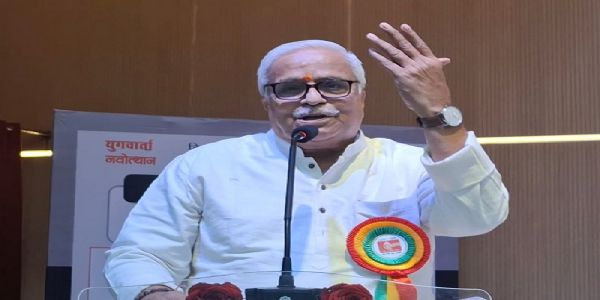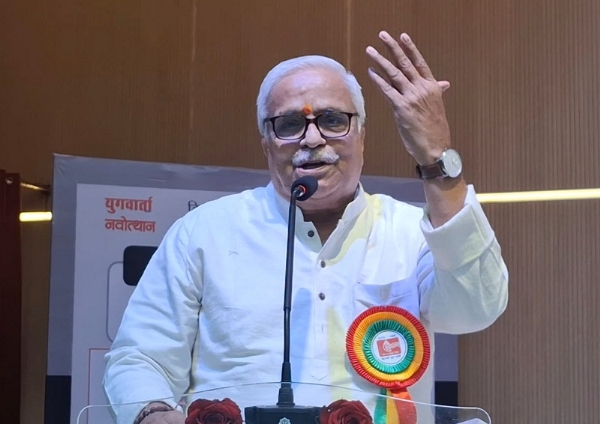
Bhopal, 19 February (H.S.): Bhaiyaji Joshi, All India Executive Member of the Rashtriya Swayamsevak Sangh (RSS), known as Suresh Joshi, declared that democracy is ingrained in the blood of society, and anyone attempting to suppress it will be consigned to dust. He emphasized that the Emergency era teaches a vital lesson: no dictator can endure if society and the nation refuse to tolerate such tyranny.
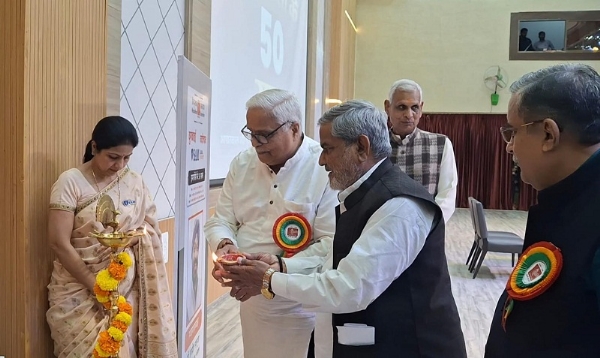
Bhaiyaji Joshi was delivering his address at the National Discourse on Emergency and Youth, organized jointly by the Hindusthan Samachar Multilingual Dialogue Committee and SAM Global University to commemorate the 50th anniversary of the Emergency.
He expressed gratitude to Hindusthan Samachar for hosting the event. He noted that few in the audience might have personally experienced that dark period, while many have only heard about it; for those who lived through it, erasing those memories remains impossible.
Constitutional Foundations and Purpose
He explained that after independence, a committee of distinguished scholars drafted the Constitution to guide the nation's future governance, delineating rights, duties, and security measures. Laws were enacted to safeguard the country, particularly during invasions in 1962, 1965, and 1972-73, without needing emergency powers then. However, the 1975 Emergency revealed the misuse of these powers during peacetime, absent any foreign threats, internal crises, or challenges to national pride and security—raising questions about the true necessity of such measures.
The Dark Chapter of Emergency
Bhaiyaji Joshi described India's unfortunate black history beginning on June 26, 1975, and ending in March 1977. The person in power sought absolute, unchecked authority, ensuring no opposition could challenge her actions. Taking refuge in draconian laws, she declared Emergency at midnight on June 25, leaving the nation stunned. Newspapers the next day were blank, as no reporting was permitted, bewildering the public.
All democratic rights were trampled solely to fulfill one individual's whims. The trigger was a challenge to the then Prime Minister's election in Allahabad High Court by Raj Narain. Despite the court's ruling of invalid election, she refused to step down, instead imprisoning the nation to protect her prestige, marking a painful assault on democracy. The infamous Maintenance of Internal Security Act (MISA) became the tool for this oppression.
Misuse Against Patriots
There were no internal security threats or major rebellions at the time. Yet, invoking one law, the regime fabricated narratives of widespread unrest and dissatisfaction to justify jailing opponents indiscriminately. Can anyone label Atal Bihari Vajpayee a traitor? Could Lal Krishna Advani plot against the nation? Would George Fernandes collude with foreigners to undermine security? The law's terror lay in barring judicial recourse, writings, rallies, or movements—deeming violators as anti-national and anti-social, fit only for prison.
Resilience of the Democratic Spirit
Is challenging the ruling party a crime? Does questioning authority constitute treason? These were the clarion calls of the nation's soul. The oppressive cycle intensified as voices against tyranny were silenced. Institutions like RSS, Vishwa Hindu Parishad, and Akhil Bharatiya Vidyarthi Parishad faced bans. Twenty-point programs were imposed to enable unchecked rule. Tyrants, blinded by ego, underestimate India's inner fabric, spirit, and resolve.
The Turning Point: Elections and Awakening
Amid this, advice came to call elections, assuming no opposition remained. With 20-25 days to polls, jailed leaders seemed voiceless. Major politicians were released, but the society was not asleep—it was vigilant. Upon opportunity, its power erupted. The 1977 elections were not merely of leaders but of the people. Fearless leaders campaigned boldly, and on schedule, the electorate delivered a resounding verdict, humbling the regime. India's youth stood discerningly, reclaiming traditions from black laws.
Enduring Lessons for Eternity
This episode imparts two timeless truths. First, India and its society will never tolerate dictatorial ambitions. Second, democracy and people's rule course through society's veins—a millennia-old tradition granting voting rights to all. Any force daring to extinguish this sacred right will meet its inevitable end in oblivion; such is its destiny.
---------------
Hindusthan Samachar / Jun Sarkar