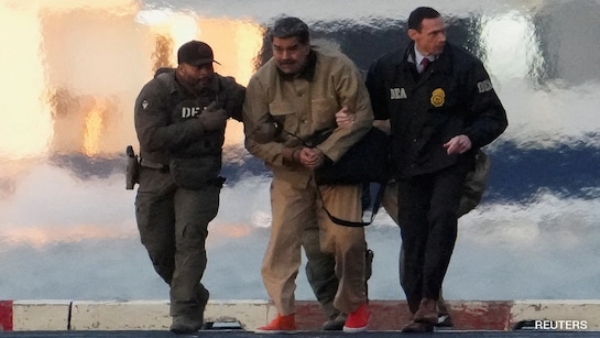
New York , 06 January (H.S.): In a scene that will reverberate through global politics, ousted Venezuelan President Nicolás Maduro made his first appearance in a Manhattan federal court, pleading not guilty to a litany of charges that include narco-terrorism conspiracy, cocaine importation conspiracy, and possession of machineguns and destructive devices.
The arraignment, held before US District Judge Alvin Hellerstein, marked a historic moment as Maduro, flanked by his wife Cilia Flores, insisted on his innocence and claimed he was “kidnapped” from his residence in Caracas.
Operation Absolute Resolve: The Capture
Maduro’s arrest followed a meticulously executed US military operation codenamed “Operation Absolute Resolve,” which unfolded in the early hours of January 3, 2026. Under the cover of darkness, US special forces, supported by over 150 aircraft, struck key infrastructure across northern Venezuela, culminating in the capture of Maduro and Flores at a Caracas residence.
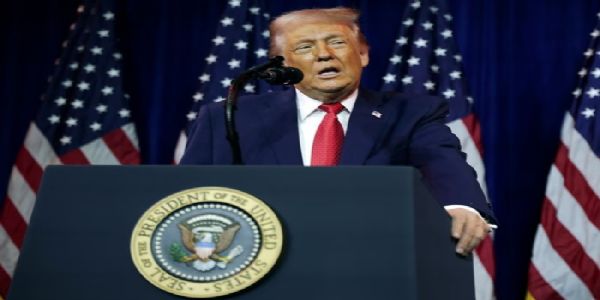
The couple was swiftly transported to the USS Iwo Jima and flown to New York, arriving at Stewart Air National Guard Base later that day. President Donald Trump announced the operation’s success, declaring that the United States would temporarily govern Venezuela and tap into its oil reserves until a “safe, proper, and judicious transition” could be arranged.
Courtroom Drama and Global Reaction
The courtroom in Manhattan was tense as Maduro, dressed in beige trousers, a khaki jacket, and bright orange shoes, was escorted by heavily armed law enforcement officers. Video footage captured his slow, limping walk, fueling speculation about injuries sustained during the operation. When asked to identify himself, Maduro declared in Spanish, “I am the president of the Republic of Venezuela, and I have been here kidnapped since January 3rd,” prompting the judge to remind him that there would be a time and place for such assertions.
Both Maduro and Flores pleaded not guilty to all charges, with Flores accused of brokering a meeting between a large-scale drug trafficker and Venezuela’s National Anti-Drug Office, allegedly accepting hundreds of thousands of dollars in bribes.
International Fallout and Legal Controversy
The US capture of Maduro has ignited a firestorm of international debate. Venezuela and Cuba condemned the operation as a “kidnapping” and an “imperialist attack,” with Cuban officials reporting over 80 fatalities, including 32 members of their military and intelligence agencies.
Meanwhile, US Attorney General Pam Bondi confirmed that Maduro and Flores would face charges in the Southern District of New York, superseding a 2020 indictment based on similar allegations.
The next court date is set for March 17, 2026, as the world watches to see how this unprecedented case unfolds.
A Historic Precedent
The operation’s timing, occurring exactly 36 years after the US invasion of Panama that led to the capture of Manuel Antonio Noriega, has drawn comparisons to past regime-change efforts.
Experts suggest that this event could reshape the geopolitical landscape of Latin America, with the US asserting its dominance and control over Venezuela’s vast oil reserves. As Maduro remains in federal custody, the implications for Venezuela’s future, and for international law, remain deeply uncertain.
This dramatic turn of events marks a pivotal chapter in the saga of Nicolás Maduro’s rule, with global consequences yet to be fully realized.
---------------
Hindusthan Samachar / Jun Sarkar