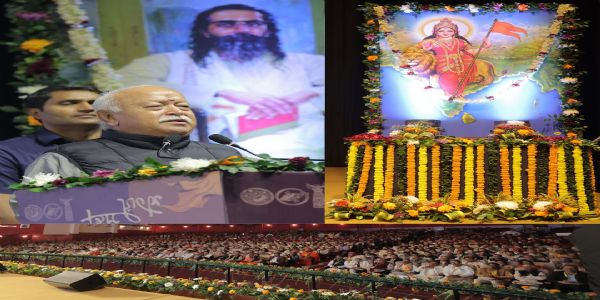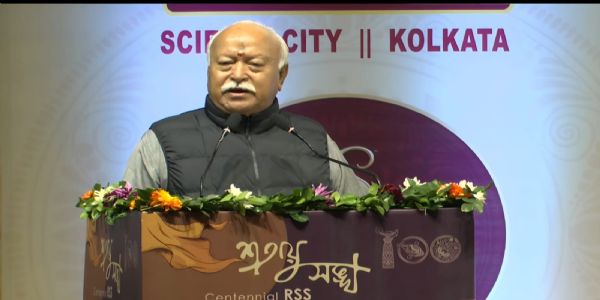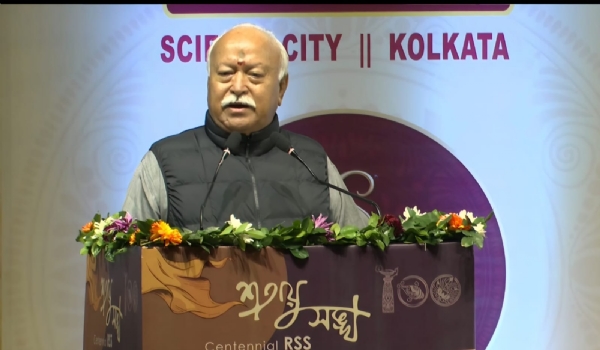
Kolkata, 21 December (H.S.) : Rashtriya Swayamsevak Sangh (RSS) chief Dr Mohan Bhagwat on Sunday said that while diversity of ideas in society is natural, unity of mind and purpose is essential for building a prosperous and strong nation. Addressing a gathering in Kolkata during the Sangh’s centenary year, he underlined that the RSS is founded on the values of friendship, collective spirit and selfless service, which form the core of its strength.
Speaking at the second session of the lecture series titled “100 Years of the Sangh Journey – New Horizons,” Dr Bhagwat elaborated on the RSS’s working style, its ideological journey and future priorities. He said the Sangh cannot be understood merely through external perceptions and opinions, and urged people to observe and experience its functioning directly at the grassroots level. He stressed that RSS volunteers are active across all sections of society and that the organisation neither controls individuals nor imposes authority, internally or externally.
Dr Bhagwat said the RSS would not have existed without its founder Dr Keshav Baliram Hedgewar, adding that understanding his life and character is essential to understanding the Sangh. Despite severe personal hardships and economic constraints, Dr Hedgewar initiated the organisation with purity of intent and selfless resolve, he said. According to the RSS chief, the organisation’s growth has been sustained by social trust and goodwill, describing the Sangh’s journey as a divine endeavour.
He noted that no other voluntary organisation has faced as much opposition as the RSS. “There were attacks, and even killings, but volunteers never stopped their work,” he said, adding that despite such adversity, Sangh volunteers harbour no bitterness. Dr Bhagwat highlighted that the RSS functions solely on guru dakshina, accepts no external funding, remains financially self-reliant, maintains detailed accounts and undergoes regular audits.
Providing an overview of the organisation’s reach, the RSS chief said the Sangh is present in more than 1.25 lakh locations across nearly 7 lakh villages in the country. He added that the RSS has reached about half of the country’s 45,000 cities and towns, with the remaining areas forming part of its future outreach goals. He said that while earlier the environment was largely hostile, requiring caution, the present atmosphere is more conducive, calling for rapid expansion of work along with a strong focus on improving the quality of volunteers during the centenary year.
Dr Bhagwat said a large number of people in society are engaged in selfless service without seeking recognition, dedicating their own resources for social good. The RSS, he said, considers this the “virtuous strength” of society. Building networks among such individuals, enhancing coordination and creating complementarity is a key role of the Sangh. He said the time has come to bring about behavioural change in society through a nationwide cadre of committed workers.
Emphasis on Five Core Commitments
The RSS chief stressed five key areas for behavioural and social transformation: social harmony, family awareness, environmental protection, self-reliance through indigenous practices, and commitment to the Constitution. He said temples, water sources and cremation grounds belong equally to all Hindus. He called for stronger family bonds, suggesting that families spend at least one day a week together to share meals and discuss traditions and values.
On environmental protection, Dr Bhagwat said efforts should move beyond discussions and be reflected in everyday life through small, practical steps. He emphasised that self-reliance and economic independence can be strengthened through indigenous practices, while children should be educated about the Preamble, fundamental duties and rights enshrined in the Constitution.
He said the collective strength of Hindus is becoming increasingly aware and will continue to grow. Stating that “India, Hindustan and Hindu are synonymous,” Dr Bhagwat said the RSS is an organisation that believes in taking everyone along. The Sangh, he added, considers the entire society as its own, and it is this sense of belonging that forms the foundation of unity.
Clarifying the nature of participation, he said it is not mandatory for everyone to attend RSS shakhas, but asserted that no other system provides training in selflessness and integrity in the manner that shakhas do.
Concluding his address, Dr Bhagwat said the RSS does not work for credit or recognition, but continues to engage with society in the collective task of nation-building.
Hindusthan Samachar / Satya Prakash Singh