Kolkata, 21 December (H.S.) :
Union Minister for Environment, Forest and Climate Change Bhupender Yadav chaired two key national-level meetings on wildlife conservation at the Sundarbans Tiger Reserve in West Bengal, focusing on the protection of tigers and elephants. Senior officials, scientists, wildlife experts and representatives from various states participated in the deliberations, aimed at reviewing progress under Project Tiger and Project Elephant and strengthening future conservation strategies.
Addressing the 28th meeting of the National Tiger Conservation Authority held on Sunday, the Union Minister said India’s tiger conservation model is globally acclaimed. He underlined the importance of science-based management, landscape-level planning, community participation, inter-state coordination and international cooperation in sustaining tiger populations. The meeting reviewed compliance with decisions taken in the previous meeting held on April 18, 2025, and assessed follow-up actions.
Detailed discussions were held on challenges facing tiger reserves across the country. Emphasis was laid on the three-tier strategy being adopted to mitigate human–tiger conflict. The progress of initiatives aimed at managing tigers outside reserve areas was also reviewed. Issues such as staff shortages, financial constraints, habitat degradation and invasive species were flagged as serious concerns, with directions issued for corrective measures.
The Authority approved several tiger conservation plans, including proposals related to the expansion and appraisal of Project Cheetah in new landscapes, tiger translocation, augmentation of prey base, landscape management planning and capacity-building programmes on health management of carnivores. The role of the National Tiger Conservation Authority in proposals forwarded to the Standing Committee of the National Board for Wildlife was also reviewed.
The Union Minister informed the meeting that work on the sixth cycle of the All India Tiger Estimation is progressing rapidly, with field surveys having commenced in November 2025. Training programmes are underway across regions, while international cooperation under Project Cheetah with countries such as South Africa, Namibia and Botswana continues to expand. Recent Supreme Court directions and their implications for tiger conservation were also discussed.
Subsequently, the 22nd Steering Committee meeting of Project Elephant was held. The committee reviewed action taken on decisions of the previous meeting and assessed the status of regional action plans prepared for southern and northeastern India, stressing the need for enhanced inter-state coordination.
The progress of the All India Coordinated Elephant Population Estimation was reviewed and described as critical for evidence-based planning. Discussions were held on a model conservation plan for the Nilgiri Elephant Reserve and on DNA profiling of captive elephants, aimed at strengthening welfare and scientific management.
Human–elephant conflict across the country was comprehensively reviewed, covering causes, mitigation measures and the status of compensation mechanisms in states. The committee also examined methodologies for elephant population assessment, integrated conservation strategies for the Ripu–Chirang Elephant Reserve in Assam, and future action plans.
It was decided that management effectiveness evaluations would be undertaken for all elephant reserves with support from the Forest Development Fund. A special study was also proposed on elephant corridors, habitat use and conflict-prone zones in the Bandhavgarh landscape.
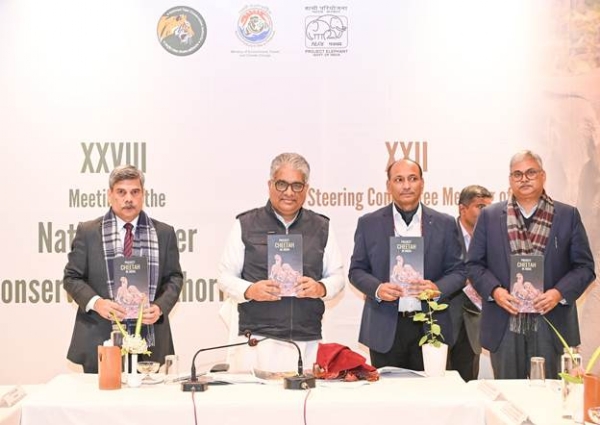
On the occasion, Union Minister Bhupender Yadav released six publications, including a book on the progress of Project Cheetah, the latest issue of the NTCA journal, a booklet on India’s institutional journey in tiger conservation, a compilation of facts and stories from tiger reserves, best practice guidelines for captive elephant management, and the December 2025 issue of the Project Elephant quarterly newsletter.
Concluding the meetings, the Union Minister reaffirmed the Centre’s commitment to ensuring a secure and sustainable future for tigers and elephants through scientific approaches, technological interventions, cooperative federalism and community-centric conservation models.
Hindusthan Samachar / Satya Prakash Singh