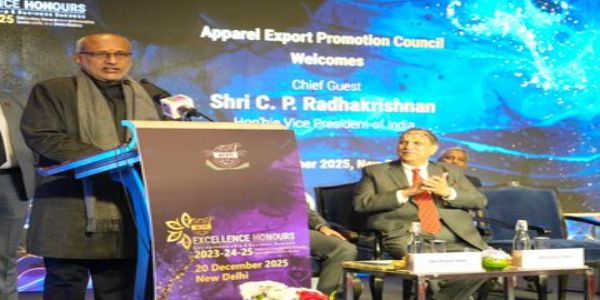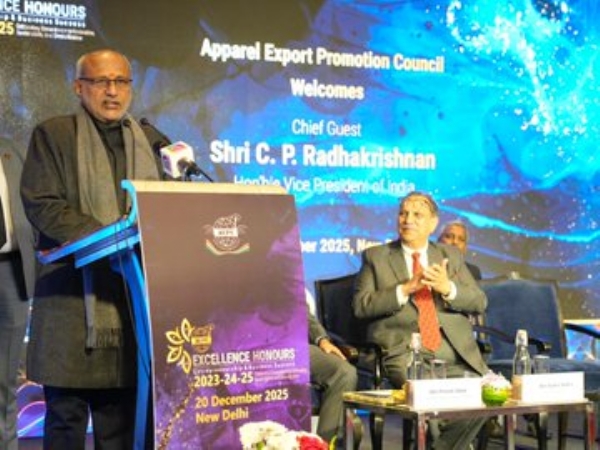
New Delhi, 20 December (H.S.): Vice-President of India, C. P. Radhakrishnan, today lauded the resilience and innovation of India’s apparel exporters during the Annual Awards Function of the Apparel Export Promotion Council (AEPC) held in New Delhi. Addressing the distinguished gathering as the Chief Guest, the Vice-President emphasized that the apparel and textile sector forms a vital pillar of India’s economy and will play a crucial role in realizing the vision of a Viksit Bharat and an Aatma Nirbhar Bharat.
Extending heartfelt congratulations to the award recipients, Radhakrishnan noted that the apparel industry directly employs over 45 million people and sustains the livelihoods of more than 100 million others indirectly. Accounting for nearly 2% of the nation’s GDP and 11% of its manufacturing Gross Value Added (GVA), the sector, he said, remains central to India’s inclusive growth strategy and export excellence.
The Vice-President commended the Government of India’s policy initiatives under the leadership of Prime Minister Shri Narendra Modi, citing progressive measures such as the PM MITRA Parks and the SAMARTH Skill Development Programme. These, he said, reflect the government’s “comprehensive and multi-dimensional support” to the textiles and apparel industry.
He also referenced the Prime Minister’s Vision 2030, which aims to transform India’s textile sector into a globally competitive Power house
.Underscoring the importance of industry partnership, Radhakrishnan remarked, “Policy support achieves its full potential only when matched by innovation, efficiency, and determination within the sector.” He praised apparel exporters for maintaining momentum amid global challenges, acknowledging their contribution to India’s export resilience.
Referring to ongoing Free Trade Agreement (FTA) negotiations, he said the government is proactively addressing sectoral challenges through global trade engagements. He urged exporters to diversify their export destinations by exploring high-potential markets in Asia, Africa, and Latin America.
Further, he called for increased value addition, product diversification, adoption of sustainable practices, and greater investment in research and development to boost the sector’s competitiveness.
Recognising the labour-intensive nature of the apparel industry—the second largest source of employment in India after agriculture—the Vice-President stressed the imperative of ensuring labour welfare and inclusive growth across all tiers of production.
Expressing confidence in the sector’s future, he noted that apparel exports are expected to double in the coming years, generating new employment opportunities and contributing significantly to national economic growth.
Drawing from his personal and professional association with the textile industry, Radhakrishnan remarked that he hails from Tiruppur, India’s hosiery and knitwear hub, and has witnessed firsthand the sector’s dynamic evolution. Reflecting on his tenure as a Member of Parliament and Co-Chairman of the Sub-Committee on Textiles under the Parliamentary Standing Committee on Commerce, he said these experiences deepened his understanding of industry challenges and policy frameworks.
The Vice-President also commended AEPC’s role as a vital bridge between the government and industry stakeholders and released its coffee table book titled “Threads of Time: Story of India’s Textiles.”
The event was attended by Manjinder Singh Sirsa, Minister of Industries, Government of the National Capital Territory of Delhi; Sudhir Sekhri, Chairman, AEPC; Dr. A. Sakthivel, Vice Chairman, AEPC; and several leading representatives from the textile and apparel sector.
---------------
Hindusthan Samachar / Jun Sarkar
20 Dec 2025