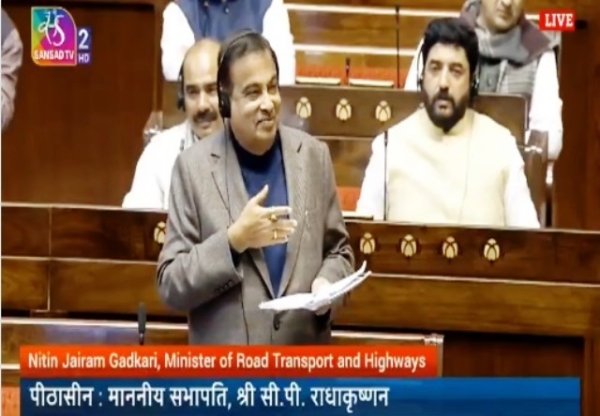
New Delhi, 17 December (H.S.): Union Minister for Road Transport and Highways Nitin Gadkari announced on Wednesday that the Multi-Lane Free Flow (MLFF) electronic toll payment system will be implemented across all national highways by the end of 2026. Once operational, vehicles will be able to pass through toll plazas at speeds of up to 80 km per hour without stopping, marking a major shift in India’s toll collection mechanism.
Replying to a question during the Rajya Sabha Question Hour, BJP MP from Jharkhand Aditya Prasad sought clarification on modernization plans for toll systems. In response, Gadkari explained that under the MLFF system, manual staff at toll gates will no longer be required. Cameras will automatically capture vehicle registration numbers, transmit data via satellite to a centralized system, and deduct the toll directly from the linked bank account.
According to him, this will save fuel, reduce congestion, and ensure smoother highway traffic.Gadkari projected that the adoption of MLFF is expected to save fuel worth ₹1,500 crore annually and increase the revenue of the National Highways Authority of India (NHAI) by approximately ₹6,000 crore. He informed the House that the new technology has already been partially introduced at select locations, with 10 contracts already awarded and another 10 in various stages of processing.
The Minister affirmed that the system will cover the entire country by the end of next year.Responding to a supplementary question, Gadkari referred to the recent accident on the Yamuna Expressway, stating that it was unfortunate that an ambulance took nearly an hour to arrive at the accident site.
To mitigate such delays, the Centre is working on a plan to provide states with 100–150 state-of-the-art ambulances. Under the proposal, state governments will operate these vehicles but must ensure that emergency response time does not exceed 10 minutes after an incident.
Highlighting the alarming state of India’s road safety, Gadkari said the country witnesses around five lakh road accidents each year, resulting in nearly 1.80 lakh deaths. Notably, 66 percent of fatalities are among individuals aged 18–34 years. Despite improvements in road design, automobile engineering, and stricter traffic laws, human errors — such as using mobile phones while driving, not wearing helmets, and lane indiscipline — remain major causes of accidents.He added that delayed medical treatment claims about 50,000 lives annually.
To address this, the government has introduced two special schemes. Under the first, any person who rushes an accident victim to the hospital will be honoured as a ‘Rahatveer’ and awarded ₹25,000. Under the second, the hospital expenses of the injured person for up to seven days, amounting to ₹1.5 lakh, will be borne by the NHAI fund.The Minister further stated that the government has asked all state administrations to adopt a unified emergency helpline number for ambulance services to ensure faster and more coordinated response during road emergencies.
Gadkari reaffirmed that these initiatives — modern tolling, efficient rescue systems, and improved road safety measures — are part of the government’s broader mission to make Indian highways safer, smarter, and more sustainable by 2030.
---------------
Hindusthan Samachar / Jun Sarkar
17 Dec 2025
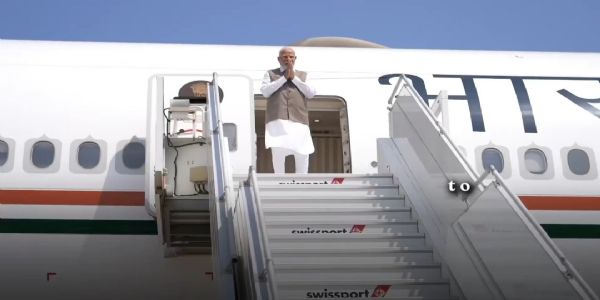
En Route to Muscat: PM Modi’s Oman Visit Set to Deepen Strategic, Energy and Diaspora Ties
17 Dec 2025