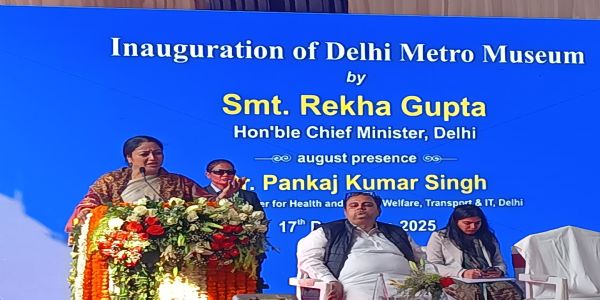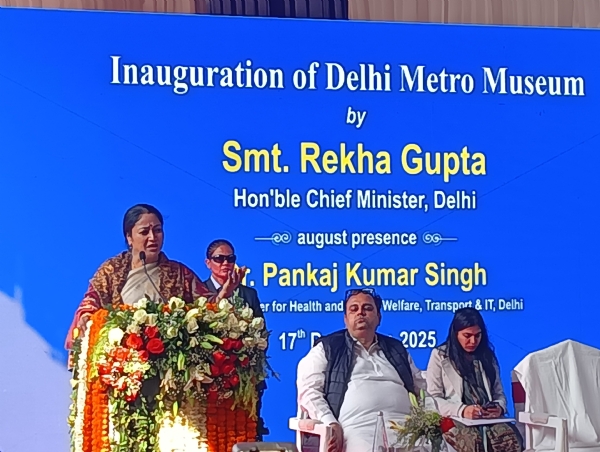
New Delhi, 17 December (H.S.): Chief Minister Rekha Gupta on Wednesday inaugurated the state-of-the-art Delhi Metro Museum at the Supreme Court Metro Station, praising the Metro’s pivotal contribution to environmental protection and public transportation in the national capital. She emphasized that the Metro has played a significant role in reducing the number of private vehicles on Delhi’s roads and in curbing pollution.
Congratulating the Delhi Metro team, the Chief Minister recalled that when former Prime Minister Atal Bihari Vajpayee approved the Delhi Metro project, few believed it would become such a remarkable success in India.The inauguration ceremony was attended by Delhi Cabinet Minister Dr. Pankaj Kumar Singh, Delhi Metro Managing Director Dr. Vikas Kumar, and several senior officials.
The museum vividly chronicles 30 years of Delhi Metro’s journey, highlighting its evolution, innovation, and growth.Speaking on the occasion, the Chief Minister noted that the Metro has been instrumental in keeping Delhi’s environment healthier and transforming its transport system into a modern, efficient network.
Referring to Vajpayee’s Metro vision, she mentioned that the capital today boasts a network of nearly 400 kilometers with 289 stations, catering to 3.5 to 3.7 million commuters daily. She added that this achievement has made travel and daily life in Delhi significantly easier.
The Chief Minister urged citizens to use public transportation facilities, especially the Metro, more frequently to help make Delhi cleaner, greener, and more sustainable. She described the Delhi Metro as a symbol of Clean, Green, and Self-Reliant Delhi, adding that the new Delhi Metro Museum is not merely a celebration of the system’s achievements but also a source of inspiration for future generations in urban transport, engineering, and innovation.
She remarked that the Metro has guided Delhi toward becoming a “future-ready city,” and through this museum, younger generations will be able to appreciate its historic milestones and technological advancements.
Meanwhile, Transport Minister Dr. Pankaj Kumar Singh highlighted how essential the Delhi Metro has become in the lives of residents, noting that its true value is felt most when one needs to reach a destination swiftly. He described the Metro as a proud emblem of modern infrastructure in New India.
Highlights of the Metro Museum
The museum spans approximately 12,000 square feet, designed on the lines of the world’s leading metro museums.
It features modern display platforms, interactive installations, and digital experiences to engage visitors.
The first phase houses over 50 panels, exhibits, kiosks, and models depicting the Metro’s design, construction, and operations.
A realistic simulator allows visitors to experience what it feels like to operate a Metro train.
Functional models of the Tunnel Boring Machine (TBM) and Launching Girder are also on display.
Interactive digital screens provide insights into the Metro’s intricate construction and working mechanisms.
Key attractions include a dedicated panel on “Metro Man” Dr. E. Sreedharan, a mock Metro tunnel, and a scaled model of the Operations Control Centre.
Other features include quiz-show screens, selfie points, and souvenir shops, offering both educational value and entertainment.
The Delhi Metro Museum will open to the public on December 19, 2025, operating from 10:00 a.m. to 4:00 p.m., Tuesday through Sunday. It will remain closed on Mondays and public holidays. The entry fee has been fixed at ₹10 per person.
---------------
Hindusthan Samachar / Jun Sarkar