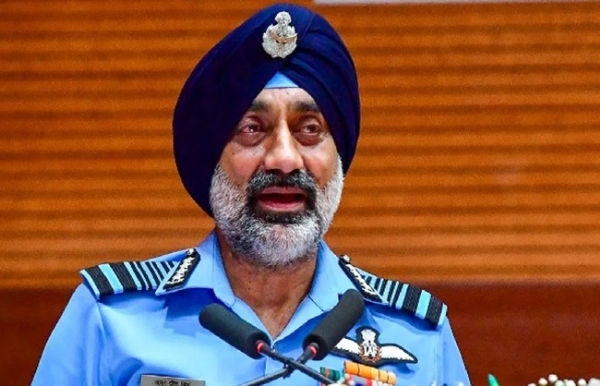
Delhi, 3 October (H.S.): Indian Air Force Chief, Air Chief Marshal A.P. Singh, on Friday declared that Operation Sindoor was the most destructive military campaign since the 1971 war. Speaking at his first press conference after the operation, he said the coordinated offensive by the three services struck deep into Pakistani territory, crippling air bases, radars, and command centres, and forcing Islamabad into a ceasefire.
Singh revealed that during the four-day conflict, the Indian Air Force shot down at least four to five U.S.-made F-16s and a C-130 transport aircraft, besides causing extensive damage to Pakistani air installations.
“Within a single night of precision, unstoppable and accurate strikes, the enemy was brought to its knees,” he said.
Airstrikes destroyed radar systems at four locations, command-and-control centres at two sites, runways at two bases, and three hangars at different stations. One surface-to-air missile (SAM) system was also neutralized.
A video released by the IAF showcased precision strikes on terrorist infrastructure and Pakistani air bases. Singh hailed Russia-made S-400 air defence systems as highly effective during the campaign.Operation Sindoor was launched after the Pahalgam terror attack and executed jointly by all three services. The scale of destruction compelled Pakistan to seek talks.
“Unlike many ongoing wars worldwide, this mission had a clear purpose, was executed swiftly, and achieved decisive results,” the Air Chief said, emphasizing that India ended hostilities after achieving its objectives.
The Air Chief underlined self-reliance as the biggest lesson from the operation, adding that dependency on foreign nations in times of crisis is not an option. He confirmed that the AMCA (Advanced Medium Combat Aircraft)—India’s fifth-generation fighter jet—is slated for its first flight within this decade and induction by 2035.
The IAF expects 30–40 new aircraft annually, with at least two squadrons entering service each year.He also announced that the Army, Navy, and Air Force have already begun work on a homegrown air defence system, ‘Sudharshan Chakra’, to enhance India’s strategic deterrence.
India’s Long-Term RoadmapAir Marshal Singh said the IAF has prepared ‘Roadmap 2047’ to strengthen combat capabilities over the next two decades. He maintained silence on India’s own operational losses, remarking, “Let Pakistan say what it wants; their words carry no substance.”
When asked about reports of terrorist camps shifting locations, he warned that India retains the capability to target them wherever they move. “Challenges will always remain. If they prepare, we must prepare better,” Singh asserted.
Hindusthan Samachar / Jun Sarkar
24 Jun 2026