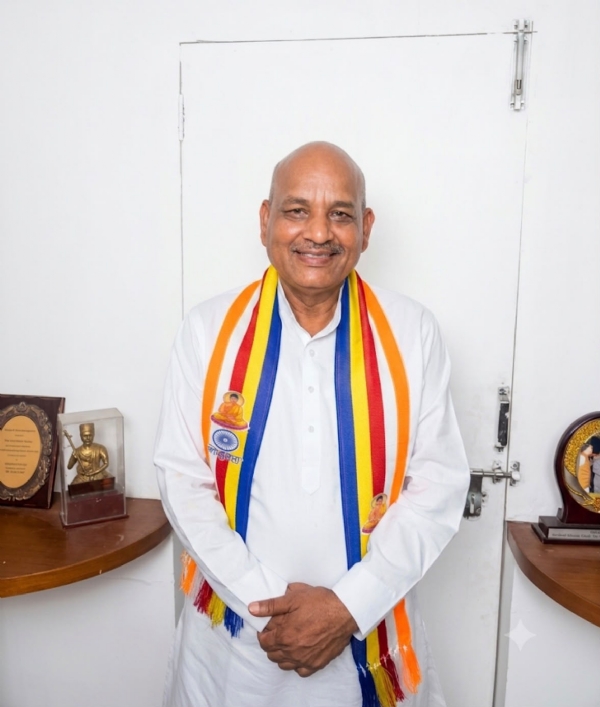
New Delhi, 08 July (H.S.): Congress leader Karamvir Singh Boudh, who recently secured a hard-fought victory in the Rajya Sabha election from Haryana, has described his election to the Upper House as a triumph of democratic values and constitutional principles. His victory came after one of the most closely watched Rajya Sabha contests in recent years, marked by allegations of cross-voting, disputes over invalid votes, prolonged delays in counting, and protests by the Congress party.
In an exclusive interview with Hindusthan Samachar, Karamvir Singh Boudh spoke in detail about the dramatic election, his transition from a senior bureaucrat to a Member of Parliament, and the issues he intends to raise during his six-year tenure in the Rajya Sabha.
Question: You emerged victorious in one of the most closely contested Rajya Sabha elections. What was your first reaction after the result?
Answer: My immediate thought was about the strength of India's democracy. Dr. B.R. Ambedkar and the members of the Constituent Assembly envisioned a nation where every citizen would receive equal respect and equal rights under the law. As I prepared to enter the Rajya Sabha, I felt that this democratic vision had once again been upheld. My election reinforced my belief in the constitutional values of equality, justice and representation.
Question: You served for nearly 32 years as an administrative officer in the Haryana Civil Secretariat and later as Secretary of the Haryana Legislative Assembly. How challenging has the transition from bureaucracy to elected public office been?
Answer: My association with social movements began during my college years. Even while serving in government, I remained actively involved in various social causes. I have always believed in Dr. B.R. Ambedkar's message of Educate, Organise and Agitate and have consistently opposed discrimination, social injustice and orthodoxy.
During my government service, I worked in several ministries and the state secretariat. Almost every Chief Minister of Haryana during that period knew me personally because I worked closely with successive governments on numerous administrative matters. Alongside my official responsibilities, I also participated in thousands of meetings, public campaigns, demonstrations outside Parliament, protests near the Supreme Court, gatherings at Delhi's Ramlila Maidan and numerous public meetings across the country.
I found immense satisfaction in working for social justice. During those years, I worked under the Confederation led by Ram Raj, who is now known as Udit Raj. Through that platform, we successfully campaigned for constitutional amendments concerning reservation in promotions. Those experiences shaped my understanding of governance as well as the struggles faced by socially disadvantaged communities.
Question: Many political observers have described your nomination as Congress' Dalit outreach strategy. What is your view?
Answer: The Congress party has consistently worked for the upliftment of Scheduled Castes and other disadvantaged communities throughout different periods of its history. Whether during the leadership of Sardar Vallabhbhai Patel, Jawaharlal Nehru, Indira Gandhi or Rajiv Gandhi, the party introduced several welfare measures, including the establishment of Jawahar Navodaya Vidyalayas, residential schools, special recruitment drives to fill backlog vacancies, Special Component Plans and land allotment schemes.
Although Dr. B.R. Ambedkar had ideological differences with the Congress, it was the Congress that facilitated his crucial role in the Constituent Assembly. The party also ensured that he became a member of the Rajya Sabha and India's first Law Minister. Congress has repeatedly created opportunities for the advancement of Dalits, and I believe my nomination is another example of that commitment.
Question: The upcoming Monsoon Session will be your first as a Member of Parliament. Which two issues will be your highest priorities?
Answer: My foremost priority will be the condition of sanitation workers across the country. Most sanitation workers have now been shifted to outsourced employment arrangements. They continue to face severe social discrimination and untouchability while also remaining among the most economically vulnerable sections of society.
The second issue I intend to raise is the implementation of the Scheduled Castes and Scheduled Tribes (Prevention of Atrocities) Act. No government has implemented this legislation effectively. Even when the Supreme Court and various High Courts deliver judgments in favour of Scheduled Castes and Scheduled Tribes, those decisions are often not properly enforced.
I will continue raising these concerns consistently in Parliament. Although the present government frequently speaks about serving those at the last mile, I do not believe sufficient work has been done for the weakest sections of society. I have been elected for six years, and I intend to use that period to highlight these issues continuously.
Question: Having spent three decades in the bureaucracy, do you believe you are better equipped than many politicians to identify administrative shortcomings?
Answer: Certainly. Whenever files relating to Scheduled Castes, Other Backward Classes or tribal communities reach government offices, many officials hesitate to act decisively. As a result, several welfare schemes remain confined to official documents rather than being implemented on the ground.
India's Constitution is among the finest in the world. The problem lies not with the Constitution but with those responsible for implementing it. Having worked extensively within the administrative system, I understand how files move, where delays occur and why implementation frequently fails.
I have also observed that many ministers and legislators belonging to Scheduled Castes and Scheduled Tribes often hesitate to strongly present issues affecting their communities before the Chief Minister. In many constituencies, development schemes remain only on paper. These are issues that I will continue raising to ensure proper implementation.
Question: Since the 2024 Lok Sabha election, the political landscape has changed considerably. The ruling alliance may not have a two-thirds majority but is very close to that figure. If a constitutional amendment is introduced, what will be your strategy?
Answer: The present government has expanded its strength in the Rajya Sabha by persuading legislators and parliamentarians from other political parties to join its ranks. Members from the Aam Aadmi Party in Punjab, the Trinamool Congress, Shiv Sena and the Nationalist Congress Party have all shifted sides. This has significantly altered the political balance.
The Women's Reservation Bill has already been passed. Under such circumstances, I question the urgency being shown regarding the delimitation exercise. If any constitutional amendment is introduced that we believe is not in the larger national interest, we will strongly oppose it.
Question: During the upcoming Parliament session, issues such as the alleged theft of offerings at the Ram Temple and the NEET examination paper leak are expected to dominate proceedings. How will your party approach these matters?
Answer: The repeated leakage of NEET examination papers raises serious questions about the government's ability to conduct examinations securely. The increasing dependence on outsourcing reflects a lack of confidence in the government's own administrative machinery.
Similarly, questions have been raised regarding the management of donations received at the Ram Temple. There should be transparency and accountability concerning such public contributions. We will certainly raise both these issues in Parliament.
Question: Farmers' issues, particularly the demand for a legal guarantee of Minimum Support Price (MSP), continue to dominate political discourse in Haryana. What is your position?
Answer: I come from a farming family, so I understand the challenges faced by farmers personally. The promise of providing Minimum Support Price has not been fulfilled in the manner expected by farmers.
Inputs such as fertilisers, seeds and other essential agricultural requirements are often not available on time. Farmers' incomes have not doubled, nor have they received the guaranteed MSP they were promised. In my opinion, the current government's policies have not adequately addressed the concerns of farmers and agricultural labourers.
Question: Employment remains another major issue in Haryana. What is your assessment of the Agniveer recruitment scheme?
Answer: Under the Agniveer scheme, young recruits serve for only four years, after which most of them have no guaranteed long-term employment. At the same time, thousands of permanent government vacancies continue to remain unfilled while contractual and outsourced recruitment is increasing.
Young people today are facing rising unemployment. This is an issue that deserves serious attention, and we will continue to raise it more forcefully in the coming months.
Hindusthan Samachar / Jun Sarkar
08 Jul 2026
NIA Conducts Nationwide Searches in Online Radicalisation Case Linked to Islamist Extremist Propaganda
08 Jul 2026
Amit Shah Directs ATRS Installation at All Airports, FRRO Offices in Every State by 2027
08 Jul 2026