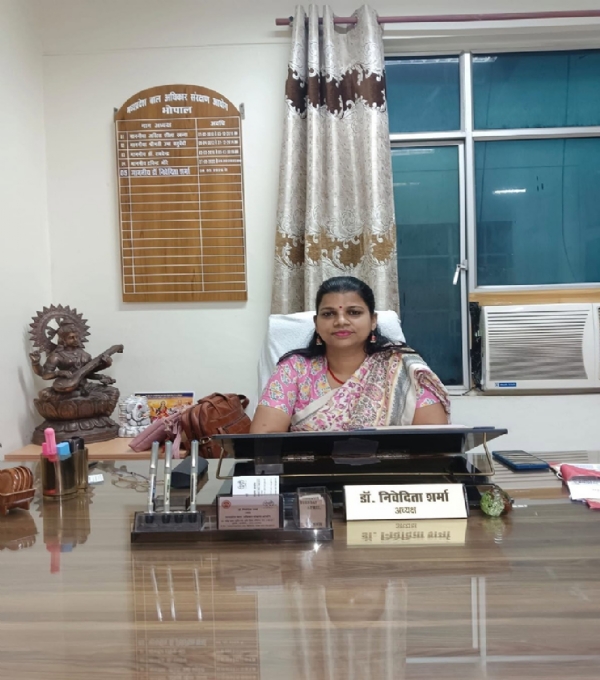
- Dr. Nivedita Sharma
(Chairperson, Madhya Pradesh Commission for Protection of Child Rights)
Every child's future rests on the love, security and trust provided by their parents. Unfortunately, however, the National Commission for Protection of Child Rights and various State Commissions frequently encounter cases where spouses use the child as a potent weapon in their personal disputes. Child psychologists consider this extremely detrimental to a child's mental development. Such children are often observed grappling with issues like a lack of self-confidence, anxiety, depression and instability in social relationships later in life.
In this context, much like in other states, cases emerging in Madhya Pradesh involve protracted legal battles over custody, visitation rights, or expenses related to maintenance and education. While the parents fight the case in court, the ultimate price is paid by the child, whose childhood becomes overshadowed by stress, insecurity and mental pressure. Amidst this, the Bombay High Court's recent verdict sends a clear message to society: a child's rights supersede any marital dispute, and equality entails the equal discharge of responsibilities alongside the assertion of rights.
Equal Responsibilities, Not Just Equal Rights
This significant case before the Bombay High Court involved a working couple. The husband challenged the Family Court's order for monthly maintenance of ₹50,000, citing a drastic drop in his income following the COVID-19 pandemic. He was servicing EMIs for two properties: one in Andheri, where his wife and son resided, and another in Panvel. Meanwhile, he was living in Bihar, working a job that paid a lower salary. Upon an objective assessment of the circumstances, the High Court reduced the maintenance amount from ₹50,000 to ₹25,000; the most significant aspect of the judgment was the observation that a claim for equality cannot be made selectively. If both the husband and wife are earning and wish to provide the best education for their child, both must contribute towards the expenses of the child's upbringing and education.
The 'Best Interest of the Child' is an Enduring Principle of the Indian Judiciary
For the past two decades, the Indian judiciary has consistently reiterated the principle that in any family dispute, the ultimate criterion should be the 'best interest of the child' rather than the rights of the parents. Numerous cases illustrate this stance. The case of ‘Gaurav Nagpal v. Sumedha Nagpal’ (AIR 2009 SC 557) is a landmark legal dispute regarding child custody and guardianship decided by the Supreme Court of India. In this case, the Court ruled that when determining child custody rights, the 'welfare and best interest of the child' must take precedence over the parents' legal rights or financial status; the child's education, mental development, emotional security and a healthy environment must be accorded the highest priority.
The case of ‘Nil Ratan Kundu v. Abhijit Kundu’ (AIR 2008 SC 3466) is another historic legal dispute concerning child custody decided by the Supreme Court of India, regarded as a milestone judgment. In this case, the Supreme Court established the principle that merely being a legal or natural guardian does not automatically confer the right to the child's custody. The Court must prioritize the child's welfare, alongside the character of the proposed guardian and the child's own wishes. Thus, the Supreme Court clarified that decisions regarding child custody are not to be based solely on legal rights but must take into account the child's physical, mental and moral development.
Similarly, in the case of ‘Yashita Sahu v. State of Rajasthan’ (2020), the Supreme Court observed that even when parents are living apart, maintaining contact with both parents is essential for the child's healthy mental development. Creating unnecessary obstacles to prevent the child from meeting the other parent is contrary to the child's interests. Beyond these instances, there are numerous other cases where the Supreme Court has reiterated that in custody disputes, the victory or defeat of a particular party is not what matters; rather, the crucial factor is the environment in which the child can best thrive. The truth is that a child needs both parents. Indeed, it is entirely inappropriate for a mother to exert undue pressure on the father by using the child as leverage.
Growing Challenges Before Child Rights Commissions
Consequently, child rights commissions have consistently emphasized that every child is entitled to a safe environment, quality education, emotional security and the affection of both parents. No child desires to see their parents locked in a years-long legal battle against each other; what they need is affection, security, and trust from both.
Psychologists believe that even if separation is inevitable, a child should never be made to feel responsible for the family's breakdown. The other parent should never be disparaged in the child's presence. Both parents should remain involved in decisions regarding the child's birthdays, school events, health and future. A child does not comprehend legal technicalities or which side the law favors; they only perceive that their parents are no longer the same with them as they once were. Therefore, the primary responsibility lies with the parents to ensure that their differences do not overshadow the child's upbringing.
The True Meaning of Equality
Women's education and economic self-reliance have increased in society, a positive shift. Similarly, the role of men has evolved beyond that of a mere breadwinner. Today, both partners share the responsibility of the family and the children. In this context, the Indian judiciary has repeatedly clarified that while a marriage may end, a couple may separate, and financial circumstances may change, the obligations of motherhood and fatherhood never cease. A child's rights are not merely part of a legal case file; they concern the security of the nation's future.
Today, the need is for parents to realize, without waiting for a court order, that their greatest responsibility is not to belittle or defeat one another, but to provide their child with a future that is safe, educated, grounded in good values, and mentally healthy. This is true equality, this is genuine parenthood, and this is the hallmark of a civilized society where the child's best interests are truly held paramount.
---------------
Hindusthan Samachar / Mayank Chaturvedi