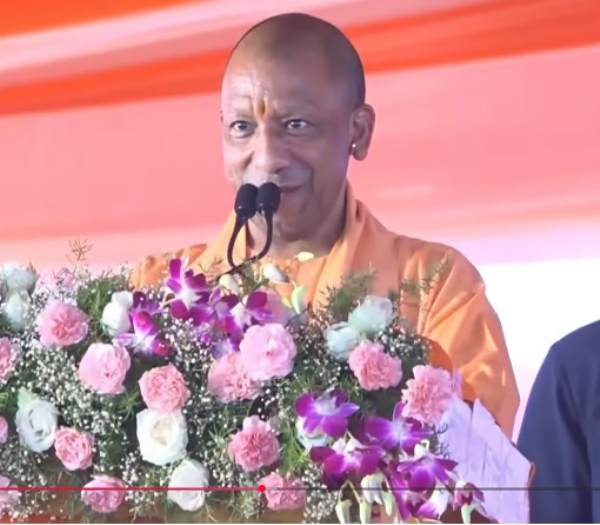
Bulandshahr, 18 July (HS): Chief Minister Yogi Adityanath, in a programme organised at Rajju Bhaiya Sainik Vidya Mandir in Bulandshahr on Saturday, gave the students the mantra of self-discipline and hard work, citing the example of Japan. He said that discipline is the biggest mantra of life. Only those have progressed and made history, who have been disciplined and hardworking and have been making efforts. You too should make efforts towards making a new history. The CM told the children that the feeling of nation first should be there in the heart. You are getting the company of the world's largest social organisation Rashtriya Swayamsevak Sangh, which has presented an ideal before everyone. If you can learn something from it, your life will be meaningful.
Chief Minister Yogi Adityanath arrived in Bulandshahr on Saturday. He addressed a program organized at the Rajju Bhaiya Sainik Vidya Mandir. Congratulating the Vidya Bharati All India Educational Institute, Chief Minister Yogi said that private trusts can also start Sainik schools, and the Sainik School in Bulandshahr was established as part of this initiative. The establishment of a Sainik School in Bulandshahr, which produces the most soldiers and military officers, is extremely important.
The Chief Minister felicitated Baba Rajpal Singh, who donated 32 bighas of land to the school. The Chief Minister congratulated Baba Rajpal Singh for donating 32 bighas of land to the Sainik School. He said that with this act, Baba Rajpal Singh demonstrated that his life, too, is dedicated to the nation. He donated this land to keep Rajju Bhaiya's memory alive in his native district.
Pancha Prana is necessary for every citizen: The Chief Minister said that during the Amrit Mahotsav of Independence, Prime Minister Narendra Modi had pledged to the countrymen to begin preparations for the centenary of Independence now and to act accordingly. To this end, he ensured five vows for every Indian. These five vows are essential for every citizen.
The Chief Minister explained the definition of Panch Prana: The first pledge is to abandon the mentality of slavery. As long as this mentality persists, no country or society can progress. A country/society progresses only by standing firm on its values and ideals.
The second pledge is to feel pride in our heritage. Everyone should feel pride in their heritage, including ancestors, sages, pilgrimage sites, and sacred texts. Heritage should be protected and collective efforts should be made to enhance it. The Chief Minister said that you voted in Bulandshahr, but the results were seen in the form of the grand Ram Temple in Ayodhya and Kashi Vishwanath Dham.
Third Vow: Focus on social equality. Untouchability, discrimination, and other evils are our problems. The country became enslaved by divisions based on caste, region, and language. We must overcome these challenges and work towards achieving them.
Fourth pledge: Reverence and respect for the uniformed forces. The Chief Minister said that when soldiers protect the borders, regardless of winter, summer, rain, day and night, we sleep peacefully. When policemen work hard day and night, we feel safe and are successful in achieving the goals of good governance. We must cultivate a sense of respect for the army, paramilitary forces, police personnel, revolutionaries who sacrificed their lives for the country, martyred soldiers, and their families.
Fifth Pledge: Civic Duty. We discuss rights at all costs, but often forget our duties. Referring to civic duty, CM Yogi said that students should remain disciplined and acquire education, teachers should maintain discipline and culture, complete the curriculum on time, and fulfill their responsibilities to the nation. This is true patriotism. Traders should conduct business honestly and oppose black marketing. Instead of exploiting ordinary consumers, they should pay their share of taxes to the government. Farmers, regardless of winter, summer, or rain, produce food to feed the nation, thus exemplifying their duty to the nation. When everyone honestly fulfills their responsibilities, this is patriotism and a duty to the nation. Only a country where people consider duty more important than rights progresses. This can also be the foundation of a self-reliant and developed India.
For a soldier, country comes first, then family, and self-interest comes last. The Chief Minister said that the Sainik School draws attention towards a disciplined and cultured environment. For a soldier, the country comes first. By sacrificing self-interest, he gives priority to the national interest and sacrifices himself while protecting the country. The CM discussed the hard work of the soldiers in the cold winter on the border and in the scorching heat of 50-52 degrees in Rajasthan, then said that for a soldier, the country comes first, then the family, and finally self-interest. When soldiers guard the hills of Kargil in temperatures of minus 20-40 degrees, the country remains safe.
Citing the example of Japan, the Chief Minister said, self-discipline is the basis of the country's progress. The Chief Minister discussed his visit to Japan with the children. He said that in 1945, the atomic bomb was misused in Japan. Two of the country's most populous cities were hit by the atomic bomb, killing millions. Japan was devastated both economically and morale-wise, yet today it is a developed economy. India gained independence in 1947, and the circumstances of both countries were more or less similar. India's progress in the last 12 years under PM Modi's leadership is commendable. India has become the fourth largest economy today, while Japan never stopped, bowed, tired, or faltered despite the atomic bomb attack. The Chief Minister said that he witnessed Japan's technology and self-discipline. Self-discipline forms the basis of progress for any community, society, and country. Japan became a developed country because of its self-discipline.
Rajju Bhaiya's life was dedicated to the preservation and promotion of India, Indianness and eternal values. Describing Rajju Bhaiya as a source of inspiration, the Chief Minister gave the students the mantra of discipline. He said that his life was dedicated to the preservation and promotion of India, Indianness, and eternal values. He was a renowned scientist and professor of physics at Allahabad University. Our government established a university in Prayagraj in Rajju Bhaiya's name. He was the fourth Sarsanghchalak of the Rashtriya Swayamsevak Sangh (RSS) (1994 to 2000). He provided leadership to millions of volunteers across the country and the world. He initiated work on numerous projects and gave them new direction. His personality was quite remarkable and miraculous. Rajju Bhaiya, who had a gentle nature, had a saintly spirit in his heart. This Sainik Vidya Mandir, built in his name, will take an important step in providing military officers to the country.
Girls will also get admission here, a hostel will be built in the name of Rajju Bhaiya's mother.
The Chief Minister said that the country's first Sainik Vidyalaya was established in 1960. Dr. Sampurnanand was the Chief Minister of the state at that time. We expanded that school significantly. We started admitting girls in the country's first Sainik School (Lucknow), run by the state government. Now the Government of India has started this arrangement for all Sainik Schools in the country. In the future, girls will also enroll in this Sainik Vidya Mandir. The government will build a hostel for girls here in the name of Rajju Bhaiya's mother. The Chief Minister also mentioned Rajju Bhaiya's father, saying that he was the Chief Engineer in the Irrigation Department. He also contributed to the good irrigation network in Western Uttar Pradesh.
Manju Tyagi presided over the program. Present on the occasion were School Management Committee President C.L. Bareja, Vidya Bharati Western Region President Manveer, BJP Regional President Nawab Singh Nagar, Patron Member M.L. Sharma, and others.
Hindusthan Samachar / Abhishek Awasthi
18 Jul 2026
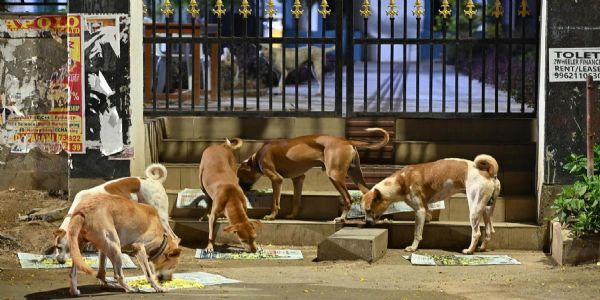
Chennai gets 40 authorised community dog feeding locations
Chennai gets 40 authorised community dog feeding locations..
18 Jul 2026
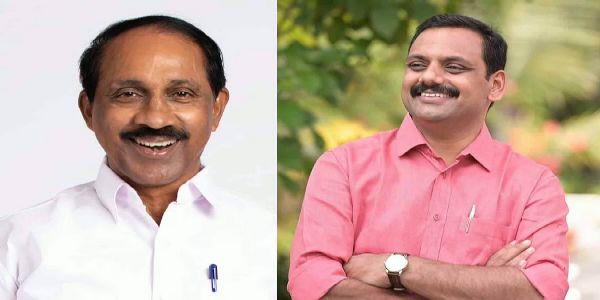
Congress govt pleader row escalates as senior leader's claim triggers fresh storm
Congress govt pleader row escalates as senior leader's claim triggers fresh storm..