Lucknow, 14 July (HS): The Joint Parliamentary Committee
(JPC), which is reviewing the Constitution (129th Amendment) Bill, 2024 and the
Union Territory Laws (Amendment) Bill, 2024, has initiated a dialogue with
various stakeholders in Uttar Pradesh regarding the proposed One Nation,
One Election law. The committee, chaired by P.P. Chaudhary, has been
meeting with MPs, MLAs, public representatives, administrative officials, and
holding discussions with various sections of society; this process continued on
Tuesday.
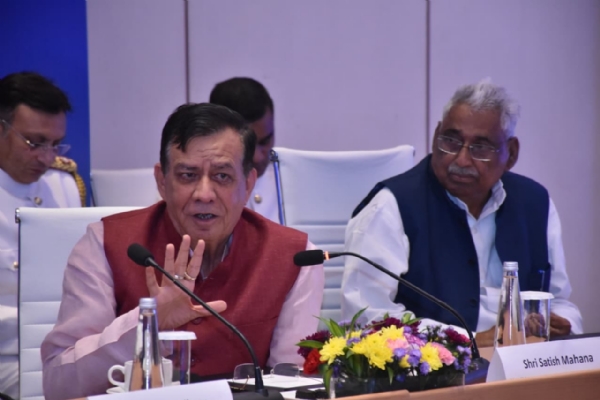
At an event held at Hotel Taj Gomti Nagar in Lucknow on
Tuesday, the committee met with Uttar Pradesh Legislative Assembly Speaker
Satish Mahana to seek his views and suggestions regarding holding simultaneous
elections. Discussions were also held with representatives of several other
public representatives and organizations.
Speaking before the committee, Assembly Speaker Satish
Mahana said that the spirit of one nation and one election has long prevailed
across the country. One nation, one election (ON-OE) would be convenient not
only for politicians but also for the public. Frequent elections impact both
the public and public representatives. Everyone's role and will are important
in the electoral process, but if elections are not held simultaneously,
frequent election activities also impact governance.
Sharing his experience, he said, I often have to be
active in the electoral process in my constituency. Whenever elections are
held, it impacts the representatives' accountability to the public and
development work. The electoral process consumes much of the representatives'
time, while the public expects continuous work on the development of their area
and the resolution of problems. If elections are held simultaneously, public
representatives will be able to devote more time to public service and
development work.
Assembly Speaker Mahana stated that frequent elections
divert a significant portion of the administrative machinery, security forces,
and government resources from the electoral process. Holding simultaneous
elections will enable better utilization of these resources and maintain the
momentum of development projects. He emphasized that public participation is
paramount in democracy. When reforming the electoral system, it is essential to
consider suggestions from all political parties, constitutional institutions, experts,
and the general public.
It is noteworthy that during its stay in Lucknow, the Joint
Parliamentary Committee is interacting with members of the Uttar Pradesh
Legislative Assembly, representatives of political parties, senior officials of
the state government, Chief Electoral Officer, legal experts, academicians,
industry and trade organizations, intellectuals and media representatives.
It is noteworthy that the Joint Parliamentary Committee,
chaired by Bharatiya Janata Party MP P.P. Chaudhary, is on a three-day study
tour to Lucknow, Uttar Pradesh. The committee's objective is to obtain
suggestions from various quarters on the constitutional, administrative, and
practical aspects of holding simultaneous elections to the Lok Sabha and state
assemblies. The committee has previously held discussions with various
stakeholders in Maharashtra, Uttarakhand, Haryana, Himachal Pradesh, Karnataka,
Gujarat, and Goa. The committee comprises a total of 39 members from the Lok
Sabha and Rajya Sabha. The suggestions received by the committee will be
incorporated into its final report.
Earlier, Lok Sabha and Assembly elections used to be held
together: Keshav Prasad Maurya
Speaking on One Nation, One Election, Deputy
Chief Minister Keshav Prasad Maurya said in Lucknow on Tuesday that when the
country gained independence, Lok Sabha and Assembly elections were held
simultaneously. However, Congress's anti-constitutional policies, including the
premature dismissal of several governments, led to staggered elections. This
led to the massive expenditure of funds from the government treasury, which
should have been spent on development, the poor, and farmers, on elections.
This has hampered the country's progress.
He said that we welcome and support the vision set under the
leadership of Prime Minister Narendra Modi, and that One Nation, One
Election must be implemented. Whether the Congress and the Samajwadi
Party fight among themselves or not, it has no impact on the BJP's health. The
BJP's victory is assured in any case. A third government (in Uttar Pradesh) is
certain in 2027, and a fourth national government in 2029. Akhilesh Yadav's
entire family has been opposing the construction of the Shri Ram Janmabhoomi
Temple. Neither Ram devotees, nor kar sevaks, nor saints can forgive the murder
of Ram devotees. Akhilesh Yadav should stop his rhetoric on the Shri Ram
Janmabhoomi issue and focus on saving his party.
Hindusthan Samachar / Abhishek Awasthi
15 Jul 2026
TN to join hands with Kerala in anti drug drive ; CM Vijay to attend awareness event with Mohanlal
TN to join hands with Kerala in anti drug drive ; CM Vijay to attend awareness event with Mohanlal..