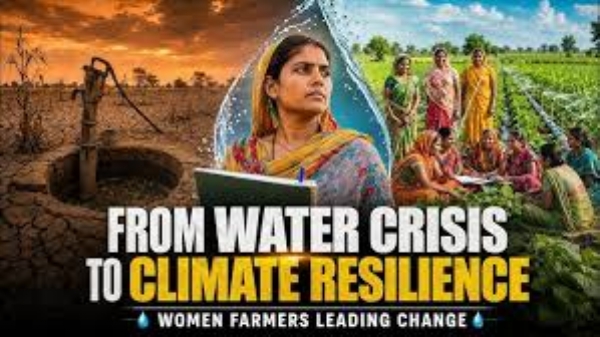
Glance at how communities in Chhattisgarh are responding to
water uncertainty through local, community-led action
Lucknow, 05 June (HS): Extreme heat stress, erratic climate,
depleting groundwater and shrinking reservoirs have pushed rural India into a
critical compound emergency, threatening drinking water security as well as
agricultural livelihoods. Apart from groundwater over-extraction and climate
variability, rural populations also have to deal with inadequate distribution
networks and intermittent supply. The silver lining in this bleak scenario?
Rural India is now actively creating sustainable solutions from the ground up.
In fact, a quiet movement is underway in Chhattisgarh to build practical and
community-led systems around water conservation, storage, and livelihood
resilience.
Sustainable resource management in Mardapal: For over 2,616
people in Mardapal Panchayat in Chhattisgarh, farming had served as the primary
means of sustenance till it faced multiple challenges like climate change,
extreme weather volatility and water scarcity. The resourceful Maradapal
community then decided to proactively leverage local ponds for enduring climate
and livelihood resilience with the help of Transform Rural India (TRI), a
development design organisation, working to transform India’s bottom 1,00,000
villages into flourishing localities. Maradapal's natural water system till now
had been underutilised, but with TRI's help, collective awareness increased,
and institutional linkages clicked into place. TRI’s locality-specific model
facilitated the synergy of the Gram Panchayat, CLFs (Cluster Level Federation),
SHGs (Self-Help Groups) and the State Fisheries Department to make the most of
existing resources. A collective aquaculture plan was mooted and the Gram
Panchayat agreed to lease two community ponds, covering over 8 acres of water
for 10 years to a group of 20 farmers. The State Fisheries Department stepped
in to offer 30 kilograms of fish fingerlings at a 50 percent subsidy.
Now water bodies that had remained underused for years are
brimming with life and opportunity as shared livelihood assets. The profound
lesson the communities have learnt is that when they take care of their natural
reserves, they return the favour as well.
It has also become clear that with institutional convergence and synergised
decision-making, community resources can offer sustenance even amid climate
challenges.
Collective water conservation in Badgaon Charbatha: Badgaon
Charbatha, a village in Chhattisgarh, had been in the throes of a persistent
water crisis caused by unpredictable rainfall and frequent extreme weather
events. The local community was well aware that they had to find a solution
urgently to ensure the safety of their health and income opportunities. Their
story took a turn when the decision-making about water governance was handed
back to women, the grassroots stakeholders, and default water managers in rural
households. TRI understood that systemic inequity could be rectified by
bringing together SHGs, village organisation leaders, Panchayat
representatives, and community members for a collective resolution. Today,
women in the village do not walk long distances to fetch water but know how to
conserve it and guide its use for collective benefit. Their hyperlocal wisdom
about water and the land has been leveraged to augment an Integrated Natural
Resource Management (INRM) framework. And now the Badgaon Charbatha community
maps their own landscape, using GIS-based tools to ascertain how water flows
and where it is collected. This work was
carried out through convergence with the Mahatma Gandhi National Rural
Employment Guarantee Act (MGNREGA) and now over 2,000 Soil Conservation
Trenches (SCTs) and over seven farm ponds have been constructed to respectively
slow down runoff and hold rainwater. With better access to water, the community
has also increased plantation efforts to strengthen ecological balance and
ensure future livelihoods. A once parched community is now the proud custodian
of its water sovereignty.
Solar-powered irrigation revives farming in Hasel village: Hasel
village in Kondagaon district of Chhattisgarh, has long depended on the monsoon
for farming. With only 7.5% of cultivable land in the region irrigated
throughout the year, most farmers were limited to a single cropping season,
leaving fields dry and livelihoods uncertain once the rains receded. As
rainfall became increasingly erratic, many turned to groundwater extraction,
putting additional pressure on an already stressed resource. Recognising that
water insecurity was at the root of the village's challenges, community members
came together to explore solutions. With support from TRI’s team of Development
Designers, villagers assessed their local water resources and identified a
Community Managed Solar Lift Irrigation (CMSLI) system as a sustainable way to
improve water access. The system draws surface water from nearby rivers and
check dams and lifts it to farms using solar-powered pumps, reducing dependence
on groundwater while ensuring reliable irrigation for agriculture. To ensure
long-term sustainability, Women Water User Groups (WUGs) were formed, which now
manage and operate the system. Farmers were also trained in system maintenance,
collective planning and water governance, while exposure visits helped them
understand how reliable water access could improve agricultural productivity
and incomes. Today, Hasel village is among the communities benefiting from 10
CMSLI sites established across Kondagaon, collectively supporting 152 farmers
and irrigating 91 hectares of land. Access to reliable water has enabled
farmers to cultivate crops during the Rabi season and prepare for multiple
cropping cycles. What was once a village constrained by seasonal water scarcity
is now demonstrating how community-led water management can strengthen
livelihoods, reduce climate risks, and create pathways to year-round farming.
Hindusthan Samachar / Abhishek Awasthi

18 Aug 2026
ED raids KPSC office, 20 other locations over Karnatak veterinary recruitment scam
ED raids KPSC office, 20 other locations over Karnatak veterinary recruitment scam..