NEW DELHI, June 4 (H.S.): Indian scientists have uncovered key structural changes in catalysts used in water electrolysis for green hydrogen production, a discovery that could pave the way for more efficient, sustainable, and low-cost electrocatalysts in the future.
The Ministry of Science and Technology said that a research team from the Bengaluru-based Centre for Nano and Soft Matter Sciences (CeNS), including Dr. Nina S. John and researcher Palash Jyoti Gogoi, collaborated with scientists from Kiel University, Germany, and the Indo-Korea Science and Technology Centre in Bengaluru to carry out the study.
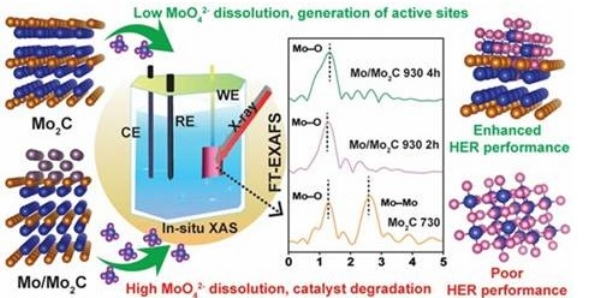
The team analysed the behaviour of molybdenum carbide-based catalysts and found that their structure is not static during hydrogen evolution reactions, but instead undergoes dynamic reconstruction.
The study employed advanced techniques such as in-situ X-ray absorption spectroscopy and in-situ Raman spectroscopy. The findings revealed that during the reaction, molybdenum carbide forms oxygen-deficient molybdenum oxide regions, which enhance hydrogen production efficiency by improving catalytic activity and stability.
In contrast, molybdenum or molybdenum carbide structures were found to rapidly oxidise, forming soluble molybdate species, which reduces catalytic performance over time.
The study further showed that the true active state of the catalyst is formed in situ during operation, rather than being present in its initial structure. This discovery establishes a fundamental relationship between local atomic structure, redox transformations, and electrocatalytic performance.
Published in the journal Materials Horizons, the research highlights that leveraging dynamic structural reconstruction can unlock the full potential of molybdenum carbide catalysts. The findings are expected to contribute to the development of more durable, efficient, and cost-effective hydrogen production systems in the future.
---------------
Hindusthan Samachar / Jun Sarkar


04 Jun 2026