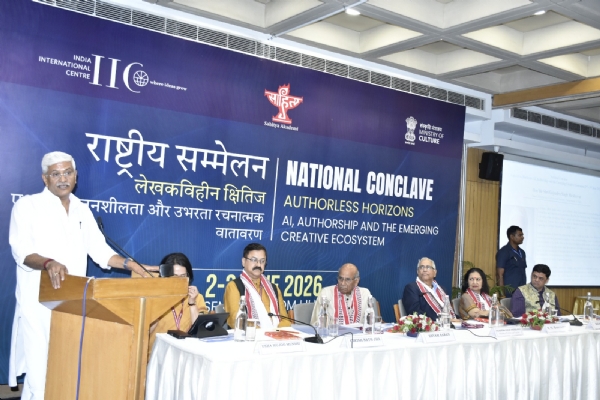
New Delhi, June 3 (HS): Union Minister for Culture and Tourism Gajendra Singh Shekhawat on Wednesday said that while artificial intelligence (AI) has the potential to expand the reach of literature through digitization, translation and dissemination, it cannot replicate the originality, imagination and emotional depth that define human creativity.
He was addressing the inaugural session of a two-day national seminar titled Authorless Horizons: AI, Authorship and the Emerging Creative Ecosystem, organised by the Sahitya Akademi in collaboration with the India International Centre. The seminar brought together scholars, writers, technologists and cultural leaders to deliberate on the evolving relationship between artificial intelligence and human creativity. The programme commenced with the National Anthem.
In his inaugural address, Shekhawat highlighted the opportunities presented by digitization and emerging technologies in enhancing access to literature, strengthening libraries and connecting younger generations with literary works. He, however, stressed that technology cannot replace the creative instincts and emotional intelligence of human authors.
Welcoming the dignitaries, Dr. Varun Gulati, Secretary of the Sahitya Akademi, felicitated the guests with angavastrams, books and fruit baskets. He outlined the central themes of the seminar, noting that rapid technological developments have raised important questions regarding the role and relevance of writers and speakers in an increasingly automated world. He said technology has become inseparable from daily life and remains directly relevant to the Akademi's mission of promoting India's languages, literary traditions and diverse voices.
Delivering the presidential address, Shyam Saran observed that despite its growing sophistication, artificial intelligence can only engage with the surface of human experience and cannot truly comprehend the depths of human sensibility, empathy and emotion.
Prof. Malashri Lal highlighted the Akademi's continuing commitment to preserving and nurturing both recognised and lesser-known Indian languages. She said the institution remains dedicated to serving language, literature and cultural memory even in the age of artificial intelligence.
Adding a technical perspective, Prof. Girish Nath Jha explained the operational mechanisms of artificial intelligence and examined its benefits and limitations in contemporary society. The inaugural session concluded with remarks by K. N. Shrivastava, followed by the rendition of the National Song, Vande Mataram.
The seminar featured three thematic sessions on Writing in the Age of AI: Redefining Creativity and Human Expression, Co-Creation or Automation? AI's Role in Shaping Literary Works, and Finding, Filtering, Creating: AI in Information Discovery for Writers and Researchers. Scholars and literary figures including Ashok Chakradhar, Rekha Sethi, Sukrita Paul Kumar, Manoj Kumar Pandey, Ujjwal Jana, Jagdish Arora and N. V. Sathyanarayana participated in the discussions.
On the concluding day, sessions focused on Reimagining Publishing: Literary Dissemination in the AI Ecosystem, The Writer's Perspective: Engaging with AI in Creative Practice, Authorship, Ownership and Ethics: Legal Challenges in the Age of AI, and Language Technologies and Literary Expression: Tools Shaping the Written Word. Experts including Bharat Bhushan, Ravi Singh, Sutapa Dutta, Vivek Sachdeva, Rohan Paul, Jay Cheema, Neeta Verma, Buddha Chandrasekhar and D. P. Singh shared insights on the growing intersection of artificial intelligence, language technologies and literary culture.
The seminar served as a platform for examining the future of literature, authorship and creative expression in an era increasingly shaped by artificial intelligence.
---------------
Hindusthan Samachar / Indrani Sarkar


03 Jun 2026