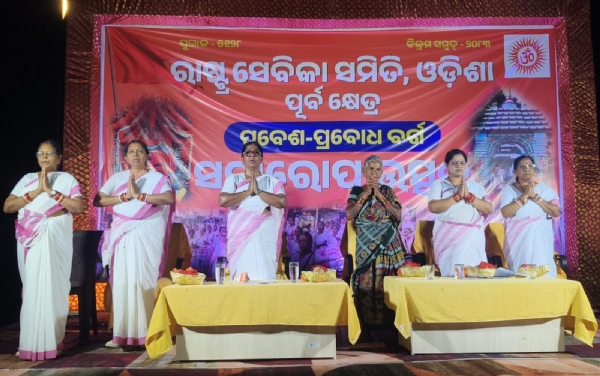
Bhubaneswar, 03 June (H.S.): Women play a crucial role in taking the nation to greater heights, fostering positive social transformation, and preserving India's cultural values, said Neeta Devi, Akhil Bharatiya Saha Sampark Pramukh of the Rashtra Sevika Samiti, while addressing the valedictory function of a 15-day Pravesh and Prabodh Varga held in Rayagada.
The training camp, organized by the Rashtra Sevika Samiti, Odisha Prant, at the MITS College campus brought together more than 100 participants from different districts of Odisha. The programme focused on developing leadership qualities, self-confidence, patriotism, and a sense of social responsibility among women.
Addressing the gathering, Neeta Devi emphasized that the Samiti is committed to the personality and character development of women and seeks to awaken, organize, and culturally strengthen Hindu women for active participation in nation-building. She said the organization works to instill a sense of duty, leadership, and national commitment among women, enabling them to contribute meaningfully to society.
Highlighting the importance of women in Indian civilization, she said that Indian culture regards women as symbols of strength, sacrifice, values, and creation. “The contribution of women is indispensable in building a healthy, strong, and organized society. As mothers, sisters, and daughters, they nurture values that strengthen families and communities,” she said.
Neeta Devi also spoke about the ideological foundations of the Rashtriya Swayamsevak Sangh (RSS) and the Rashtra Sevika Samiti. Referring to RSS founder Dr. Keshav Baliram Hedgewar, she noted that the organization was established in 1925 with the objective of uniting Hindu society. Inspired by the same vision, Laxmibai Kelkar founded the Rashtra Sevika Samiti in 1936 to empower women and prepare them for nation-building.
She stressed that Indian women have historically played a significant role in social development and cultural preservation. Calling upon the trainees to face contemporary challenges with courage and confidence, she urged them to draw inspiration from Sanatan values and actively contribute to building a strong and self-reliant nation.
The programme also featured tribal social activist Sumi Jhodia, a prominent leader of an anti-liquor movement in tribal areas. Sharing her experiences, she spoke about the challenges she faced while campaigning against alcohol abuse and highlighted how awareness and community participation helped bring positive change in society.
During the 15-day camp, participants underwent extensive training in yoga, physical exercises, self-defence techniques, and Ghosh (traditional band) practice, including instruments such as the flute and aanak. Daily intellectual sessions, discussions, patriotic songs, cultural programmes, and Shakha activities were conducted to promote awareness, discipline, teamwork, leadership, and commitment to national service.
Training in self-defence disciplines such as danda, jyeshtha, and niyuddha was also provided to enhance confidence, courage, and organizational skills among the trainees.
The valedictory programme was attended by senior functionaries of the Samiti, including Kshetra Pracharika Latika Padhi, Odisha Prant Karyavahika Arati Vaishakh, and Sah-Karyavahika Vaijayanti Rana, who guided the participants and encouraged them to play an active role in social and national development.
---------------
Hindusthan Samachar / Monalisa Panda


03 Jun 2026