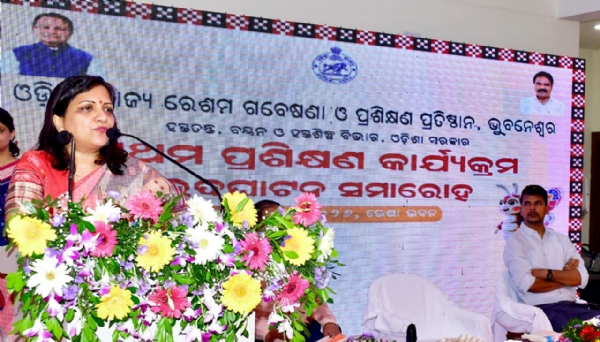
Bhubaneswar, 19 June (H.S.): The Odisha State Sericulture Research and Training Institute (OSSR&TI) has launched its first Farmers’ Training Programme on “Tasar Host Plant Nursery and Its Management”, aimed at strengthening sericulture-based livelihoods and enhancing the technical skills of farmers engaged in silk production across the state.
The five-day training programme, being held from June 19 to June 23, was inaugurated at the institute’s newly established training facility, “Resha Bhavan,” which was formally opened earlier this year during the Toshali National Crafts Mela at Janata Maidan in Bhubaneswar.
Addressing the inaugural session as the chief guest, Guha Poonam Tapas Kumar, Commissioner-cum-Secretary, Handlooms, Textiles and Handicrafts Department, emphasized the significant role of sericulture as a sustainable year-round livelihood activity. She noted that sericulture provides a reliable source of income to thousands of farming families and contributes substantially to rural economic development.
The Commissioner highlighted that nearly 15,000 traditional families, comprising around one lakh people, are actively engaged in sericulture in Odisha. She explained that India produces four varieties of silk—Mulberry, Tasar, Eri and Muga—each differing in host plants, lifecycle, cocoon characteristics and silk quality.
Focusing on Tasar cultivation, she said more than 46,828 Scheduled Tribe and Scheduled Caste families across 14 districts of Odisha are involved in the traditional practice. The sector produces over 50,000 Tasar cocoons annually, generating approximately ₹6 crore in income for tribal farmers with minimal investment.
The Commissioner also highlighted the contribution of Eri and Mulberry sericulture in the state. Around 2,000 farmers cultivate Eri silk on nearly 1,000 acres, producing approximately seven metric tonnes of cocoons annually, while Mulberry cultivation supports nearly 1,000 tribal and Scheduled Caste farmers, generating annual earnings of around ₹50 lakh.
Reiterating the Odisha Government’s commitment to the welfare of sericulture farmers, she announced several initiatives, including the establishment of serisheds for cocoon rearing, insurance coverage for sericulture farmers, special hostel facilities and training programmes for women sericulturists, and efforts to revive the spinning unit at Bhagamunda in Keonjhar district.
She also congratulated the farming community for Odisha’s achievement of securing the top position in the Sericulture Review conducted by the Central Silk Board, attributing the success to the dedication and hard work of the state's sericulture farmers.
Speaking on the occasion, Somesh Kumar Upadhyay, Director of Textiles and Handlooms, said the state government plans to invest ₹274 crore over the next five years under the Chief Minister’s Sericulture Development Scheme to promote all four varieties of silk in Odisha.
He further informed that 11 training programmes would be conducted over the coming year to provide skill development opportunities in local languages to 165 beneficiaries.
---------------
Hindusthan Samachar / Monalisa Panda
19 Jun 2026
Union Finance Minister Arrives in Shillong; Inaugurates North East’s largest Organic Spice Processing Plant

19 Jun 2026
Kerala HC pulls up probe team in SNDP microfinance scam case
Kerala HC pulls up probe team in SNDP microfinance scam case..