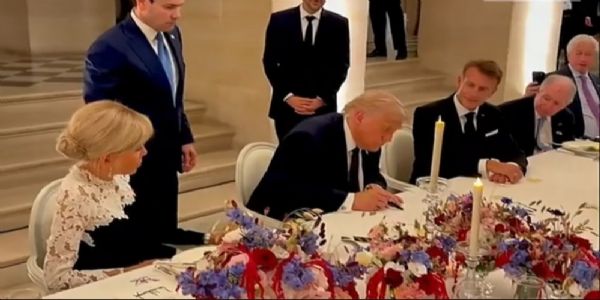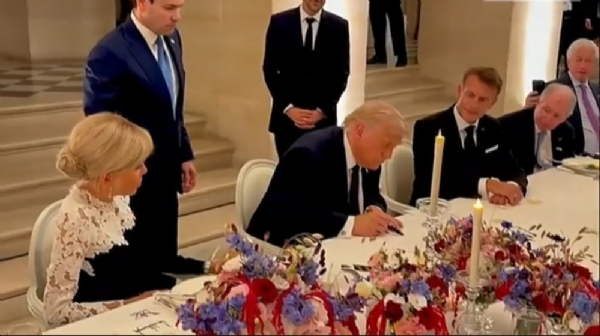
Versailles (France), 18 June (H.S.): United States President Donald Trump on Wednesday signed a hard copy of a Memorandum of Understanding (MoU) with Iran at the Palace of Versailles, formally endorsing a landmark agreement aimed at ending months of conflict between the two countries and laying the foundation for a broader regional peace process.
The signing took place following the conclusion of the G7 Summit in France during a dinner hosted by French President Emmanuel Macron. Iranian President Masoud Pezeshkian also signed the document separately, completing the formal endorsement of the agreement by both sides.
Speaking to reporters after the ceremony, President Trump confirmed the signing, saying, It's signed, and described the agreement as a significant step toward restoring stability in the region. He later acknowledged that reaching the agreement had been difficult but expressed confidence that it could pave the way for lasting peace.
The memorandum outlines a framework for de-escalation and future negotiations between Washington and Tehran. Under the agreement, Iran has committed not to procure or develop nuclear weapons, while the United States has agreed to take steps toward easing sanctions and facilitating Iran's return to international energy markets through a phased process.
The document also provides for the reopening of the strategically important Strait of Hormuz, a critical global shipping route for crude oil and liquefied natural gas. The restoration of maritime traffic through the waterway is expected to ease pressure on global energy markets and improve international trade flows.
In addition, the agreement envisages the creation of a multi-billion-dollar reconstruction framework for Iran during the next phase of negotiations. It also commits both sides to pursuing a permanent end to military hostilities across the region, including in Lebanon, while emphasizing respect for sovereignty and territorial integrity.
Officials involved in the negotiations said the memorandum was signed in both English and Persian to ensure clarity and avoid differences in interpretation. The agreement is expected to serve as the basis for further diplomatic discussions aimed at implementing its provisions.
While several countries welcomed the development as a major diplomatic achievement, political reactions within the United States remained divided. Supporters described the agreement as an opportunity to reduce regional tensions, whereas some lawmakers questioned its long-term implications and called for greater congressional oversight before implementation.
The signing at the Palace of Versailles marked the formal conclusion of President Trump's engagements in France following the G7 Summit and represented one of the most significant diplomatic developments in West Asia in recent years.
---------------
Hindusthan Samachar / Jun Sarkar