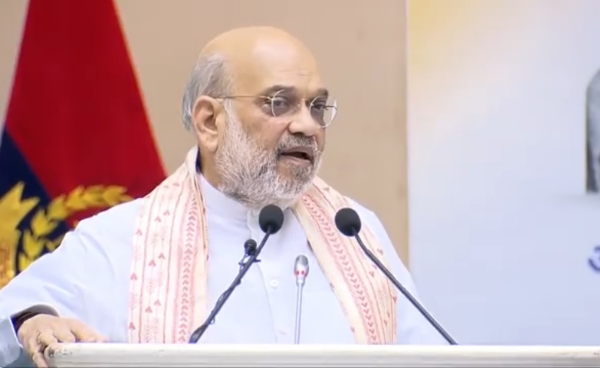
New Delhi, May 22 (H.S.): Union Home and Cooperation Minister Amit Shah on Friday said that the government is rapidly working towards transforming the India-Bangladesh and India-Pakistan borders into technologically advanced “Smart Borders,” and an impenetrable border security grid will be established within the next year.
Addressing the Border Security Force (BSF) Investiture Ceremony and the Rustamji Memorial Lecture at Vigyan Bhavan, Shah stated that the Ministry of Home Affairs would soon unveil the Smart Border project equipped with drones, radars, advanced cameras and other modern technologies.
He also announced that within the next two months, the Modi Government would introduce a major welfare programme for personnel of the BSF and all Central Armed Police Forces (CAPFs). Shah said that after the implementation of the programme, security personnel would be able to perform their duties with greater confidence, while the Ministry of Home Affairs would take responsibility for the welfare concerns of their families.
He said that under the Smart Border concept, all forms of advanced technologies are being integrated into the BSF’s security framework, which would not only make border management easier but also significantly strengthen it.
Shah further stated that the Central Government has decided that by the 60th anniversary of the BSF, the Ministry of Home Affairs will provide technical support to establish a uniform smart border design along 6,000 kilometres of the country’s borders. He assured BSF personnel that once implemented, the entire border adjoining Bangladesh and Pakistan would become even more secure and impenetrable.
The Home Minister said that the government is committed not only to stopping infiltration but also to identifying and deporting every infiltrator from the country, ensuring that India’s demographic structure is not artificially altered. He said the BSF would have to thwart all conspiracies aimed at changing the country’s demography.
Shah observed that traditional methods alone are no longer sufficient for border security. He stressed the need to strengthen the security grid in coordination with state police forces, armed forces, paramilitary units, the Narcotics Control Bureau, intelligence agencies and state administrations. Border security, he said, must be viewed as a regional responsibility rather than an isolated task.
He pointed to emerging threats such as illegal infiltration, counterfeit currency, cyber challenges, drone-based smuggling of weapons and narcotics, and hybrid warfare, stating that these challenges require entirely new strategies.
The Home Minister recalled that during the tenure of former Prime Minister Atal Bihari Vajpayee, the principle of “One Border, One Force” was implemented, after which the BSF was entrusted with securing the country’s most sensitive borders with Pakistan and Bangladesh. He said the BSF has consistently responded strongly to every challenge and enemy provocation.
Shah noted that the BSF, which began in 1965 with just 25 battalions, has now become the world’s largest border guarding force with nearly 2.70 lakh personnel. He also paid tribute to more than 2,000 BSF personnel who have made the supreme sacrifice since 1965.
He said that under the leadership of Prime Minister Narendra Modi, India has significantly strengthened its defence policy since 2014 and has responded firmly to every attack from Pakistan.
The Home Minister also congratulated the recently formed women’s mountaineering team of the BSF for successfully scaling Mount Everest and hoisting the Indian tricolour there.
Referring to internal security challenges, Shah said there was a time when Naxalites carried out massacres fearlessly while governments limited themselves to dialogue. He stated that the present government has strengthened India’s security architecture in line with the spirit of the Constitution, and that the BSF has played a major role in this transformation.
He added that through the combined efforts of the Central Reserve Police Force (CRPF), BSF, Indo-Tibetan Border Police (ITBP) and state police forces, “Red Terror” has now been eliminated and India has become free from Naxalism.
Shah further stated that the BSF’s jurisdiction, which earlier extended up to 15 kilometres from the border, has now been increased to 50 kilometres. He added that the West Bengal Government has also decided to provide all pending land required for border-related infrastructure, with some portions already handed over.
He said that governments in Tripura, Assam and West Bengal now share the policy view that infiltration into the country must be stopped. Shah added that it is now the responsibility of the BSF not only to secure the borders but also to maintain regular coordination with village-level officials and local police stations.
---------------
Hindusthan Samachar / Jun Sarkar


22 May 2026
Deadline Extended for Submitting Comments and Counter-Comments on Public Wi-Fi Expansion Consultation Paper

22 May 2026