Prayagraj,
13 May (HS): Under the banner of Gyandeep Seva Sansthan, a symposium on “Folk
Theatre Styles: Tradition and Modernity” was organized at the auditorium of
K.P. Convent, with the support of the Ministry of Culture, Government of India,
New Delhi on Wednesday. Several experts in folk theatre shared their thoughts.
The
keynote speaker, Uday Chand Pardesi, explained forms like Doha, Chaubola, Alha,
and Bahretabeel through song, illustrating how traditional styles were used in
Nautanki and how they are being adapted in modern times, as well as how they
might evolve in the future. He emphasized that folk theatre reflects the truth
of life, and in the art of Nautanki, the realities of life are vividly
portrayed.
Senior
theatre artist Dr. Rama Montrose remarked that folk theatre has always been the
cultural heritage of Uttar Pradesh and will remain so. She explained that in
earlier times, Nautanki revolved around mythological and spiritual themes.
During the freedom struggle, Nautanki became a medium to spread messages among
the masses—through dialogues and songs, artists inspired people against British
rule and ignited the flame of independence. At that time, men even played
female roles since performances lasted all night. In contrast, modern Nautanki
usually lasts an hour or so, staged in halls with modern costumes, sets, and
lighting.
Dr.
Rajkumar Srivastava added that folk theatre is a cultural identity that needs
preservation to safeguard its original form. He stressed that new experiments
should continue with time, as the art form is rapidly changing. Senior theatre
artist Pradeep Rao observed that ongoing social, economic, political, and
cultural changes also influence folk theatre, making media an increasingly
important tool for its survival and growth. Dr. Aditya Singh highlighted that
innovation in themes and craft is essential to keep audiences engaged.
Chairperson
Ranjan Pandey expressed concern over the deteriorating state of folk theatre,
urging preservation of both tradition and modernity so that future generations
are not deprived of this art form. The principal of K.P. Convent also shared
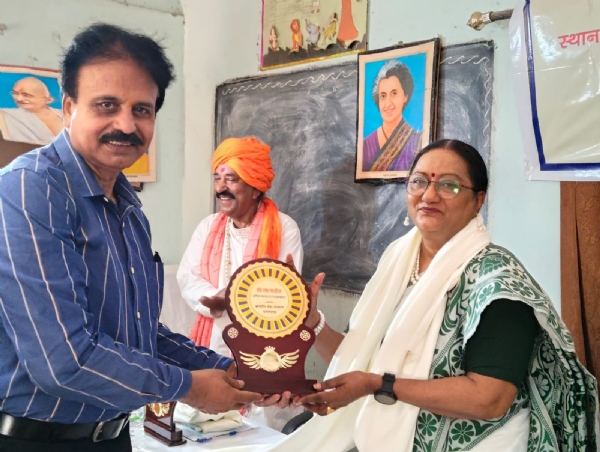
her views. The institution honored Uday Chand Pardesi, Dr. Rama Montrose, and
Dr. Ranjan Pandey with shawls and mementos. The symposium was attended by
senior theatre artists Rakesh Verma, Surendra Singh, Afzal Khan, Ashok
Srivastava, Sonia Singh (Poonam), Meena Arora, senior journalist Jasmine Lal
from Mirzapur, Alimuddin, Gulrez, Anupam Saxena, and others. The event was
conducted by Dhirendra Nath Srivastava. Finally, the institution’s secretary
and theatre artist Kiran expressed gratitude to all distinguished speakers,
guests, and media representatives present at the seminar.
Hindusthan Samachar / Abhishek Awasthi

13 May 2026