Lucknow,
April 9 (HS): Chief Minister Yogi Adityanath said that weavers are not only the
bearers of tradition but also a strong pillar of the state's economy.
Therefore, ensuring their income, dignity, and livelihood stability is a top
priority for the state government. He said that weavers currently face
challenges such as rising raw material costs, a lack of design and modern
technology, and limited market access. These problems cannot be addressed
solely through planned assistance, but rather through the development of a
robust and coordinated system. The Chief Minister directed the development of a
new, result-oriented, cluster-based action plan in this direction.
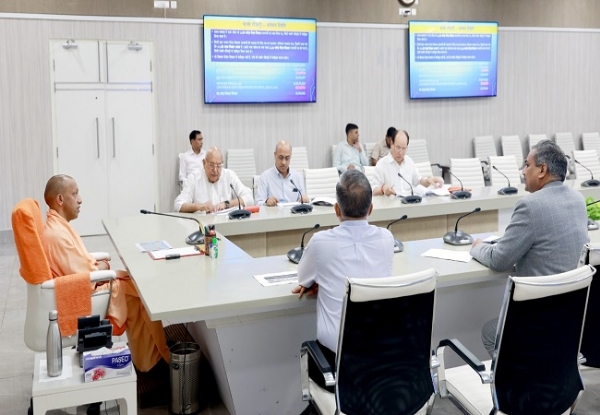
Chief
Minister Yogi was informed by officials at a review meeting of the Handloom
Department on Thursday that approximately 1.99 lakh weavers are employed in the
state. Uttar Pradesh ranks sixth in the country in this sector. The state is a
leader in the production of carpets, rugs and mats, while the state also has a
strong presence in products like bedsheets, furnishings and blankets. The
country's total handloom exports in the year 2024-25 stood at Rs 1178.93 crore,
in which Uttar Pradesh's contribution was Rs 109.40 crore (about 9.27 percent).
The
Chief Minister directed that clusters be identified in weaver-dominated areas
and developed there to integrate production, quality, and marketing. He
clarified that these clusters should not be limited to production alone, but
should develop into a complete value chain, where design, branding, packaging,
and market access are ensured within a single framework.
The
meeting discussed in detail aspects such as cluster selection, baseline
surveys, preparation of detailed project reports (DPRs), effective
implementation, and ongoing monitoring. The Chief Minister called for a limited
number of weavers within each cluster to be organized and developed into
registered units, promoting collective production and marketing. Furthermore,
these clusters should be integrated with modern technology, advanced equipment,
and skills training to improve the quality and competitiveness of their
products.
Emphasizing
the need to strengthen design and marketing, the Chief Minister stated that
product success is possible only if it meets market demand. He directed the
effective implementation of institutional mechanisms such as
Designer-cum-Marketing Executive and Design
House/Sourcing-Buying Agency/Export House. This will ensure improved
product quality, access to larger markets, and increased weavers' income. The
Chief Minister urged special attention to the expansion of digital platforms,
e-commerce, and branding to connect weavers directly with consumers.
During
the meeting, the Chief Minister also highlighted the need for greater efforts
to reduce the electricity bills of powerloom weavers. On the Chief Minister's
instructions, the Handloom Department and the Power Corporation will jointly
develop an action plan in this regard. The Chief Minister emphasized the
promotion of solar energy, saying this would reduce weavers' electricity costs
and provide them long-term relief. He directed the development of an effective
action plan in this direction.
The
Chief Minister said that Uttar Pradesh's weaver community is a vital pillar of
the state's rich tradition, employment, and economy. Therefore, a balanced,
transparent, and practical policy should be formulated that provides real
relief to weavers, revitalizes the industry, and strengthens the state's
traditional weaving industry. Minister for Micro, Small, and Medium Enterprises
and Khadi, Rakesh Sachan, along with departmental officials, were present at the
meeting.
Hindusthan Samachar / Abhishek Awasthi

09 Apr 2026
Sexual exploitation, religious conversion in multinational company in Nashik, 5 arrested
09 Apr 2026