Washington DC, 29 April (H.S.):
U.S. authorities have announced that Donald Trump’s portrait will appear inside a limited‑run series of American passports issued this summer to mark the nation’s 250th anniversary of independence. The move, framed by the administration as a “patriotic” stamp on the year‑long America250 celebrations, is being scrutinized by critics as another step in Trump’s effort to embed his personal image across federal institutions.
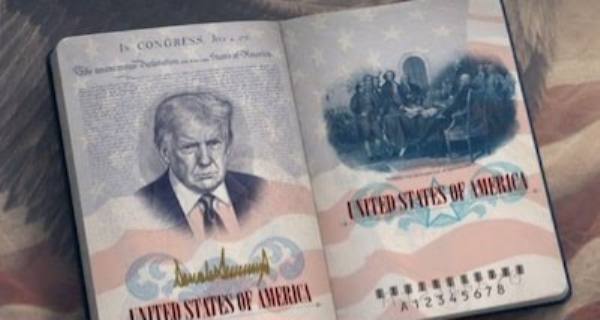
The State Department has released mock‑ups of a special‑edition U.S. passport whose inside cover will show Trump’s official portrait overlaid on a stylized rendering of the Declaration of Independence, accompanied by his signature in gold.
Another interior page will depict the well‑known historical painting of the Founding Fathers signing the document, threading Trump visually into the narrative of America’s revolutionary origins.
These passports will be issued only in limited numbers, with officials specifying that they will be available at the Washington Passport Agency and “for as long as there is availability,” at no extra cost beyond the standard fee. It remains unclear whether applicants can opt out of the Trump‑themed version or will receive it automatically if present in the batch at the time of issuance.
The passport initiative follows a series of symbolic emblazonments of Trump’s name and likeness across federal properties and instruments of state. In recent months, his portrait or banner has appeared on, or near, key Washington buildings, while the Kennedy Center and the former site of the U.S. Institute of Peace have been rebranded in ways that foreground his presidency.
Last month, the Treasury Department also confirmed that Trump’s signature will begin appearing on U.S. dollar notes, a first for a sitting president and a move that further blurs the line between the office and the occupant.
Unlike many other democracies, where national symbols typically hew to historical or abstract imagery, the Trump administration has increasingly treated federal branding as a channel for personal legacy‑building.
Analysts point out that few modern democracies have ever placed a sitting leader’s face on identity documents such as passports, a practice more commonly associated with autocratic regimes or monarchies. The United Kingdom, for example, features King Charles III on banknotes, but he is a non‑political head of state, whereas Trump is an active, partisan president whose stylized image is now being fused with a core civic document.
Political commentators in Europe and Asia have warned that the cumulative effect of such symbolic moves—on passports, buildings, currency, and institutions—reinforces a perception of “personalized rule” and risks eroding the traditional separation between the presidency and the state itself.
At the same time, Trump’s domestic base has generally welcomed the changes as a sign of national pride and a break from what his supporters describe as “bureaucratic anonymity.”
The Trump‑themed passport is part of a broader “America250” campaign centered on July’s 250th anniversary of the Declaration of Independence.
The administration plans a series of large‑scale events, including a “Great American State Fair” and a multi‑week roster of parades, concerts, and military displays, all framed as a celebration of national resilience and “America First” renewal.
The new passport design will debut in July, coinciding with the core of these festivities, and is expected to be heavily promoted as a collectible and a marker of citizenship during what the White House describes as a “defining moment in American history.”
Critics, however, caution that when a sitting president places his likeness on such a fundamental document, it may normalize the expectation that future administrations will treat national symbols as personal branding tools rather than neutral representations of the state.
---------------
Hindusthan Samachar / Jun Sarkar
29 Apr 2026