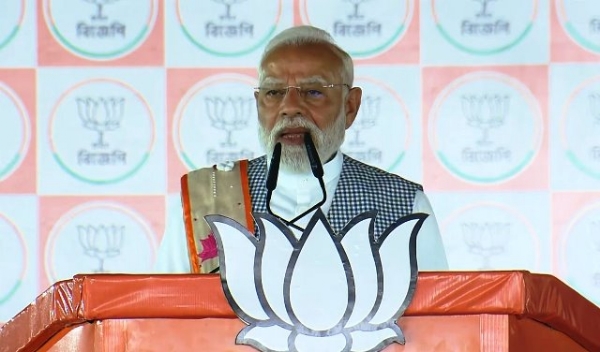
Barrackpore,West Bengal, 27 April (H.S.): Prime Minister Narendra Modi has asserted that historic Barrackpore, the very ground that inspired the 1857 uprising, will now become the springboard for political change in West Bengal. Addressing a Vijay Sankalp public meeting in Barrackpore on Monday, he declared that the region’s legacy of resistance will be re‑ignited to end what he called the “maha‑jangal raj” of the Trinamool Congress (TMC) and install a BJP‑led government in the state.
A pledge to return for oath‑taking
PM Modi told the packed crowd that he is leaving Barrackpore confident this will be his final election rally of the campaign and that he will be back after May 4—this time to attend the BJP’s swearing‑in ceremony in West Bengal. “It is both my fortune and my duty to serve Bengal, to secure it and to protect it from big challenges. I will not step back from this responsibility,” he said, framing the state’s upcoming election as a decisive break from the past 15 years of TMC rule.
Roadshow as a “tirtha‑yatra”
The Prime Minister described his journey from the helipad to the rally ground as a “pilgrimage”, recalling that thousands had gathered in the early morning just to bless him. Even beyond the designated route, he said, people stood in long queues and he repeatedly felt drawn to move among them. He also spoke of a woman from Arambagh whom he could not meet personally and promised to visit her in the future, adding that the people of India are his only family after decades of constant travel across the country.
PM Modi launched a sharp attack on the TMC accusing the party of closing down factories that create jobs while allowing those that produce homemade bombs to flourish. He cited the Barrackpore industrial belt, claiming that about a dozen jute mills have shut in the last few months, while “bom‑factories” and the party’s criminal syndicates have expanded.
“On one side, employment‑giving factories are closing down; on the other, bomb factories and TMC’s syndicates are spreading. This is the maha‑jangal raj of the Trinamool Congress,” he said.
He accused the party of reducing its politics to abuse, threats and lies, and of refusing to account for its 15 years in power. He also claimed that the TMC had forgotten its own slogan of “Ma, Mati, Manush” and done nothing meaningful for women, farmers and youth.
Safety of women and appeal to voters
On the theme of women’s safety, PM Modi urged voters to cast their ballots for the lotus symbol so that law and order can be strengthened and girls can step out of their homes without fear. He asked women to remember those who, in the name of the TMC, perpetrate abuse and violence when they go to polling stations.
He recalled the decades of Bengal’s exodus, saying that jobless youth have been forced to migrate while the elderly are left alone, calling this emotional separation “painful.” He pledged that if the BJP comes to power, generating local employment for youth would be a top priority.
Announcing five major employment‑related steps to be taken after May 4, he said government recruitment will be transparent and time‑bound, vacant posts will be filled, and employees will finally receive the benefits of the Seventh Pay Commission. The BJP government will also promote the creative economy, guarantee 125 days of work in rural areas, and extend benefits to street‑vendors in cities under welfare schemes.
PM Modi reminded the audience that West Bengal had once sent Syama Prasad Mukherjee to Parliament, laying a strong foundation for the Bharatiya Jana Sangh. He said that the recent removal of Article 370 in Jammu and Kashmir fulfilled one of Mukherjee’s key visions, and that a BJP government in Bengal would next focus on Bengal’s prosperity and the resolution of its refugee problem.
He also criticised promises to turn Kolkata into a “London‑like” city, claiming that instead its identity has been altered and the city has been burdened with illegal migrants. He appealed to citizens to unite and protect Kolkata’s character.
Finally, invoking the triad of “Anga, Banga and Kalinga”, he said the BJP has already found acceptance in Bihar and Odisha and that now it is Bengal’s turn.
Re‑contextualising “Vande Mataram” as the mantra of the 21st century, he urged the people of Bengal to see the song’s spirit as the guiding force for the state’s revival and for the larger project of Viksit Bharat—a developed India by 2047.
By casting Barrackpore not just as a campaign stop but as a symbolic launchpad for change, PM Modi sought to energise the BJP’s base while presenting his party as the only credible alternative to the TMC in West Bengal’s upcoming assembly elections.
---------------
Hindusthan Samachar / Jun Sarkar
27 Apr 2026
Prime Minister Modi to virtually inaugurate Meghalaya’s indoor cricket academy on April 28

27 Apr 2026