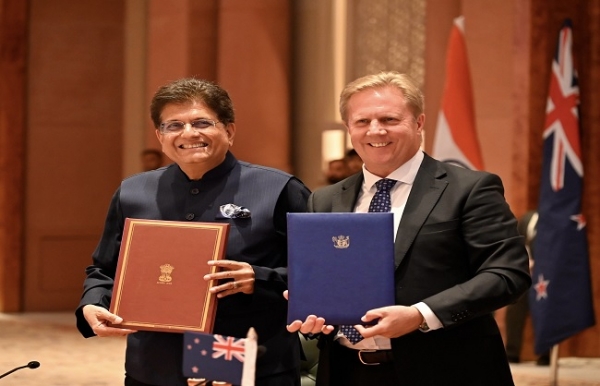
New Delhi, 27 April (H.S.): India and New Zealand have today signed a bilateral Free Trade Agreement (FTA) aimed at deepening two‑way trade and investment, with Commerce and Industry Minister Piyush Goyal and New Zealand’s Trade and Investment Minister Todd McClay exchanging documents in the presence of both governments. The historic pact, sealed in New Delhi, is intended to double two‑way goods and services trade to about 5 billion dollars within five years from the current level of 2.4 billion dollars in 2024.
Duty‑free access for Indian exports
Under the FTA, New Zealand will grant 100% duty‑free access to all Indian exports, across all tariff lines. This includes textiles, garments, leather, footwear, jewellery, engineering goods and processed foods—labour‑intensive sectors that are expected to gain sharper cost‑competitive advantage in the New Zealand market. The move is projected to boost micro, small and medium enterprises (MSMEs) and support job creation in India’s export‑oriented industries.
Previously, New Zealand charged tariffs of up to 10% on products such as ceramics, carpets, motor vehicles and auto parts; the FTA will remove these duties and allow Indian products to compete more equitably against goods from other trading partners. Indian manufacturers will also benefit from duty‑free access to inputs such as timber logs, coking coal and scrap metal, lowering production costs and improving global competitiveness.
In return, India will provide duty reductions or eliminations on about 70.03% of its tariff lines, which account for roughly 95% of India’s imports from New Zealand by value. Around 29.97% of tariff lines, however, have been kept out of liberalisation to protect sensitive sectors, including:
Dairy (milk, cream, cheese and other milk products);
Other animal products (excluding sheep meat);
Certain agricultural items (onion, chickpeas, peas, maize, almonds);
Sugar, artificial honey, fats and oils;
Arms and ammunition;
Jewellery and gems; and
Copper and aluminium‑linked products.
India will also eliminate tariffs on nearly 30% of New Zealand’s tariff lines, covering products such as wood, wool, sheep meat and raw leather, while reducing duties on a further 35.60% of lines in tranches of 3, 5, 7 and 10 years. These include petroleum oils, malt extract, vegetable oils and selected machinery.
On the New Zealand side, products such as wine, pharmaceuticals, polymers, aluminium, and iron‑steel goods will gain improved tariff access to India, enhancing their competitiveness. Special provisions place manuka honey, apples, kiwi fruit and albumin under tariff‑rate quotas, allowing controlled market entry while managing price and supply impacts.
The agreement also includes a commitment to facilitate around 20 billion dollars of investment into India over the medium term, with a built‑in “safeguard‑type” clause to rebalance the deal if the investment target is not met. This platform is expected to strengthen India–New Zealand economic ties, not only in trade, but also in services, skilling and technology cooperation, as both countries seek to deepen their Indo‑Pacific presence.
---------------
Hindusthan Samachar / Jun Sarkar
27 Apr 2026
Prime Minister Modi to virtually inaugurate Meghalaya’s indoor cricket academy on April 28


27 Apr 2026