New Delhi, 18 April (H.S.):
The Special Cell of Delhi Police has arrested four radicalized youths from three states in a major counter‑terrorism operation aimed at thwarting an Improvised Explosive Device (IED) plot inspired by the extremist concept of “Ghazwa‑e‑Hind.” The accused had allegedly begun assembling remote‑controlled bombs using everyday items such as toy‑car circuitry, ball bearings, and nails, while scouting sensitive locations in the national capital.
Deputy Commissioner of Police Praveen Kumar said the Special Cell’s ND‑R (National Detection and Response) team mounted the operation on the basis of carefully gathered intelligence inputs. Inspector Vinay Pal and Manoj Kumar led raids in Maharashtra, Odisha, and Bihar, detaining the four suspects and seizing materials linked to IED manufacturing from their possession.
A case has been registered under various provisions of the Bharatiya Nyaya Sanhita, 2023, at the Special Cell police station, indicating that the offence includes sections dealing with terrorism, conspiracy, and possession of explosive substances.
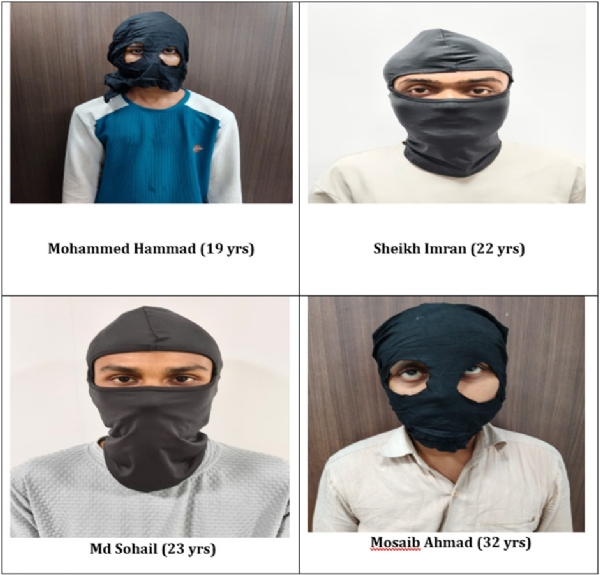
The arrested men have been identified as Mosaib Ahmad alias Sonu alias Kalam of Thane, Mohammad Hammad of Mumbai, Sheikh Imran of Bhubaneswar, and Mohammad Sohail of Katihar in Bihar.
According to police, all four were communicating through encrypted, closed social‑media groups on platforms such as Signal, Telegram, and WhatsApp, where they discussed themes of khilafat (caliphate) and jihad, drawing inspiration from the idea of a “black‑flag army” entering India from Khorasan to establish Islamic rule.
The investigation revealed that two members of the module were trying to cobble together remote‑controlled IEDs at the local level, using toy‑car circuit boards, ball bearings, nails, and other easily available components. Police said Hammad collected and supplied these materials while Mosaib, who is a mechanic by profession, was helping assemble the device, combining household hardware with electronic circuits to create a crude explosive device.
The design, sources indicated, could have been used to target crowded or symbolic sites in urban areas, exploiting ordinary‑looking objects to evade detection.
Online radicalisation and fundraising
Investigators also allege that Mohammad Sohail used social media to incite youth and raise funds for the purported “jihad.” He reportedly shared his bank account details and QR codes, encouraging supporters to channel money to the group, which the probe views as an attempt to funnel finances to a radical network operating through encrypted chats.
Online posts analyzed by the Special Cell show that he framed donations as contributions to a religious‑military cause, blurring the line between charity and militant financing.
Meanwhile, Sheikh Imran is said to have promised training in weapons handling and physical fitness to other members of the module, for which he reportedly demanded money.
According to police, he also visited Delhi in December 2025, conducting reconnaissance of high‑profile and sensitive locations such as the Red Fort and India Gate. In addition, he posted digitally edited images of the Red Fort with black flags on social media, in an apparent bid to provoke and mobilize sympathizers around the imagery of the caliphate.
Ideology and ongoing probe
Police officials told reporters that the accused were deeply influenced by the Ghazwa‑e‑Hind ideology, which imagines an apocalyptic war in the Indian subcontinent culminating in the establishment of an Islamic caliphate.
Far from merely sharing extremist ideas, the group allegedly sought to actively participate in such a scenario and to radicalize others, particularly impressionable young people, through closed online circles.
Mobile phones and other digital devices have been seized from all four suspects, and forensic teams are now sifting through their chats, cloud storage, and messaging apps to trace wider links. Investigators are also scanning for possible external handlers, including operatives linked to Pakistan‑based or cross‑border extremist networks, to map out the full extent of the module and any additional plots under preparation.
Law enforcement officials have described the operation as a critical step in curbing the spread of online radicalisation and pre‑empting home‑grown attacks, while stressing that vigilance around encrypted platforms and digital fundraising will remain a priority in the months ahead.
---------------
Hindusthan Samachar / Jun Sarkar
18 Apr 2026