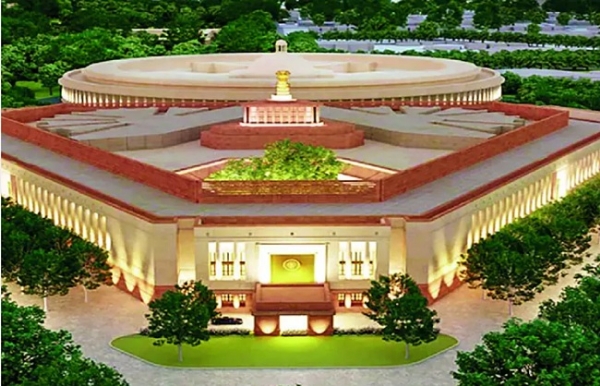
New Delhi, 18 April (H.S.): In the fallout from the Lok Sabha’s rejection of the Constitution (131st Amendment) Bill that would have implemented 33% women’s reservation, the ruling NDA camp and the opposition bloc have launched sharp, mutually accusatory salvos, casting the outcome as both a “black day” for women and a “victory for the Constitution.”
While the government and its allies blame the opposition for sabotaging a historic opportunity for women’s empowerment, the opposition insists it has merely guarded constitutional principles and federal balance against a politically timed move.
Union Minister of Parliamentary Affairs Kiren Rijiju accused the Congress and other opposition parties of bearing an “unwashable stain” for blocking the bill, calling it a landmark measure to reserve seats for women in Parliament and state assemblies that was sacrificed on political grounds.
He warned that the opposition would be forced to pay a political price for denying women their rights, and described the defeat in the Lok Sabha as a “black day” for the nation.
BJP MP Nishikant Dubey said that if the 2023‑based delimitation formula embedded in the bill had been approved, it would have altered seat distribution to the disadvantage of several states, particularly in the South. He alleged that the Congress and Tamil Nadu Chief Minister M.K. Stalin were doing an injustice to South India. Annapurna Devi, Union Minister for Women and Child Development, claimed that the Congress has historically opposed women’s reservation and does not genuinely want women to get their due share of political power.
Other NDA leaders, including Ramdas Athawale and Chirag Paswan, argued that the government’s aim was to increase the number of seats and provide adequate representation to women, calling the proposal balanced and fair, and accusing the opposition of deliberately stalling it. BJP MPs Kangana Ranaut and Jagdambika Pal said the bill was not just about delimitation but about preventing 33% women’s representation in the 2029 Lok Sabha, while Upendra Kushwaha of the RLSP claimed that the opposition had blocked a genuine effort to give women constitutional protection.
Facing this barrage, the opposition rejected the “anti‑women” label and framed the vote as a defence of the Constitution and federalism. Priyanka Gandhi Vadra, Congress General Secretary, insisted that the Congress is not opposed to women’s reservation but could not support the government’s attempt to tie the quota to delimitation in a way that alters the demographic balance of Parliament.
She accused the government of using the issue as a political strategy rather than a sincere empowerment measure.
Congress MP Shashi Tharoor said the women’s reservation principle should be enacted, but that linking it to delimitation was wrong, calling the move a political game that instrumentalises women’s issues for partisan gain. He offered that the Congress would back a separate women’s reservation bill, detached from census and delimitation, if the government tables it. Rajeev Shukla argued that the voting numbers show a united opposition that has firmly upheld its position against the government’s design.
Dimple Yadav, Samajwadi Party MP, contended that the bill was discriminatory toward Dalit and OBC women because it did not provide for sub‑quotas for backward‑class women and tried to divide women along caste lines. Mahua Moitra of the Trinamool Congress asserted that the core Women’s Reservation Act was already passed years ago, and that the new bill was merely a ploy to push delimitation forward by a “misleading strategy.”
The clash over the defeated bill has now moved beyond the Lok Sabha to state capitals and public forums, with both sides gearing up for a broader battle over gender‑inclusive political representation and federal seat distribution.
The ruling camp is likely to use the bill’s rejection to accuse the opposition of anti‑women bias, while the opposition may seek to rally support around the themes of constitutional sanctity, regional equity, and opposition to seat‑reduction fears in the South and smaller states.
With the 2029 Lok Sabha elections in view, the debate over how and when 33% women’s reservation is implemented promises to remain a central, and highly polarised, chapter in India’s political narrative.
---------------
Hindusthan Samachar / Jun Sarkar
19 Apr 2026
PM Modi to Lead ‘Victory Resolve’ Rally in West Midnapore as Election Campaign Intensifies
18 Apr 2026
PM Modi Vows Undaunted Commitment to Women’s Empowerment in National Address After Reservation Bill Setback
18 Apr 2026