New Delhi, 18 April (H.S.):
The Bharatiya Janata Party (BJP) has lashed out at the Congress and all other opposition parties, branding them as opponents of women’s rights after the Constitution Amendment (Women’s Reservation) Bill failed to secure the required two‑thirds majority in Parliament.
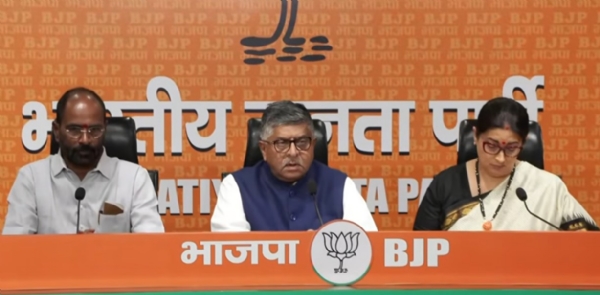
At a joint press briefing at the party headquarters on Saturday, BJP leaders Ravishankar Prasad and Smriti Irani argued that the opposition had “celebrated” the defeat of a historic opportunity to empower women, while the BJP remained committed to delivering their constitutional rights.
The BJP defended the government’s approach of tying 33% reservation for women in the Lok Sabha and state assemblies to a delimitation exercise, describing delimitation as an integral part of seat re‑allocation.
Ravishankar Prasad reiterated that, under Article 81(2) of the Constitution, Lok Sabha seats are allocated on the basis of population, and without delimitation, any meaningful redistribution of seats is impossible.
He claimed that by focusing on preserving the current 543‑seat framework, the Congress and its allies risked reducing the share of southern states, and therefore their stance endangered federal balance as much as women’s representation.
Prasad cited Union Home Minister Amit Shah’s remarks that the total number of Lok Sabha seats could be raised from 543 to around 850, which he said would allow 33% women’s reservation to be implemented effectively while also accommodating demographic shifts.
The party also insisted that census and delimitation were necessary prerequisites and that the opposition was using these processes as a political shield rather than engaging on the core issue of women’s rights.
Smriti Irani accused the Congress and its allies of treating the 33% women’s reservation demand “with mockery” instead of seriousness, framing the struggle not merely as a battle for power, but as a struggle for the “right to equality.”
She claimed that during the Congress’s long periods in power, 110 million women were left without toilet facilities and 250 million remained unbanked, underscoring what she described as a “failure” in basic empowerment that contrasted sharply with the BJP‑led NDA government’s gender‑budgeting framework.
Irani alleged that the Congress had adopted a “dual standard” on delimitation and women’s reservation, accusing the party of undermining women’s rights while also disrespecting the constitutional scheme. She argued that the Congress‑led INDIA bloc’s opposition to the proposed constitutional amendments reflected not only a lack of faith in the delimitation process, but also a deeper disbelief in women’s capacity to claim their rightful place in the political mainstream.
Ravishankar Prasad responded sharply to comments reportedly made by Congress leader Priyanka Gandhi Vadra, who had described women as “instruments” being used by the ruling side. He termed the choice of words as “unacceptable” and “deserving of strong condemnation,” asserting that Indian women are not objects to be used, but full‑fledged citizens entitled to dignity, respect, and constitutional rights.
He insisted that the BJP’s position was rooted in making women equal stakeholders in governance, while the Congress and its allies had, in effect, “crushed the political aspirations of women” by blocking the bill.
The party used the press conference to reinforce its narrative that the BJP, not the opposition, is the true champion of gender‑inclusive politics. Leaders said that the defeat of the bill in the Lok Sabha would be turned into a political talking point, with the NDA presenting the opposition’s vote as a betrayal of women and the Congress in particular as the “biggest enemy of women’s power.”
At the same time, they reiterated that the BJP‑led government would continue to push for women’s reservation, delimitation, and gender‑responsive fiscal policies, framing these as part of a long‑term project to deepen women’s political and economic agency in India.
---------------
Hindusthan Samachar / Jun Sarkar
19 Apr 2026
PM Modi to Lead ‘Victory Resolve’ Rally in West Midnapore as Election Campaign Intensifies
18 Apr 2026
PM Modi Vows Undaunted Commitment to Women’s Empowerment in National Address After Reservation Bill Setback
18 Apr 2026