New Delhi, 01 April (H.S.):
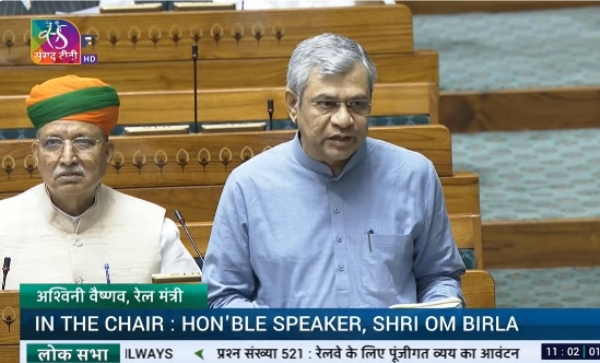
Indian Railways has achieved a record freight‑transportation milestone, moving 1,670 million tonnes (MT) of cargo during financial year 2025‑26, Railways Minister Ashwini Vaishnaw has said. The volume, disclosed in Lok Sabha during Question Hour, marks a 3.25 per cent increase over the previous fiscal and highlights the expanding role of rail in the country’s logistics system.
Vaishnaw noted that the record‑breaking 1,670‑MT haul was supported by substantial infrastructure investment enabled by the largest‑ever budget allocations for railways under Prime Minister Narendra Modi’s leadership. He said the benefits of this decade‑long capital‑spending drive are now visible in the form of faster, safer and more reliable services for both passengers and freight customers.
The minister also highlighted that Indian Railways operated around 25,000 trains daily on its network during the year while running 76,352 special trains in the fiscal to absorb seasonal and commodity‑driven surges in demand.
On the safety front, the Railways recorded only 16 serious accidents in FY 2025‑26—its lowest tally in the last 50 years—underscoring a major improvement in operations, signalling upgrades and track‑maintenance protocols.
At the same time, the locomotive and wagon fleet has been strengthened. The Railways manufactured 1,914 locomotives in the fiscal, a number that exceeds the annual production of several other countries. The number of wagons in use also rose by 4.56 per cent, increasing from 27.91 million in 2024‑25 to 29.19 million in 2025‑26, reflecting the growing demand for cheap, reliable and efficient rail‑based transport.
The 3.25 per cent jump in freight loading was led by strong growth in fertilisers and pig iron & finished steel traffic. Fertiliser transport rose 13.49 per cent, while the movement of pig iron and finished steel went up 13.11 per cent, signalling robust demand from agriculture and expanding industrial activity.
Infrastructure‑linked commodities further reinforced the uptrend. Iron‑ore loading grew 6.74 per cent to 190.12 MT, while cement shipments increased 4.74 per cent to 157.17 MT, both of which indicate that construction and infrastructure projects continue to gather pace across the country.
The surge in freight volumes has been broad‑based across regions. South Western Railway (SWR) delivered the highest growth at 14.89 per cent, followed by North Central Railway (12.62 per cent), East Coast Railway (10.42 per cent) and West Central Railway (10.06 per cent).
Other zones also posted positive growth: Eastern Railway (+0.78 per cent), East Central Railway (+0.39 per cent), North Eastern Railway (+0.25 per cent), Northeast Frontier Railway (+6.75 per cent), North Western Railway (+5.17 per cent), South Central Railway (+2.59 per cent), South East Central Railway (+3.18 per cent), Southern Railway (+1.10 per cent) and Western Railway (+3.57 per cent).
Railway officials say this balanced‑regional growth signals a steady rise in nationwide freight‑transport capacity and supports balanced regional‑economic development.
By touching 1,670 million tonnes of freight in a single year, Indian Railways has reaffirmed its role as a critical engine of India’s economic expansion. The ministry stressed that rail not only reduces logistics costs for manufacturers, farmers and builders but also de‑congests roads and lowers carbon emissions, making it a cornerstone of India’s green‑mobility and sustainable‑development agenda.
With the FY 2025‑26 figures in place, the groundwork is now set for even higher freight‑loading targets in the coming years as the network continues to modernise, expand and align with the country’s rising industrial and infrastructure‑related freight demand.
---------------
Hindusthan Samachar / Jun Sarkar