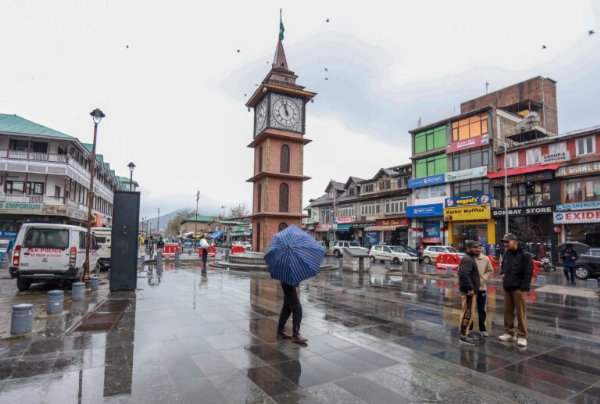
Jammu, 01 April (H.S.): Jammu and Kashmir faced a rainfall deficit of 34 per cent in March despite several Western Disturbances in the month, officials said on Wednesday.
They said J-K received 100.7 mm of rainfall, below the normal of 152.9 mm, placing the month in the “deficient” category.
Srinagar recorded 88.5 mm rainfall against a normal of 115.0 mm, marking a 23 per cent deficit, while the winter capital Jammu witnessed a sharper shortfall of 43 per cent, receiving 52.4 mm against 92.3 mm, the officials said.
They said Shopian district in south Kashmir recorded the highest rainfall deficit of 74 per cent, followed by Kulgam at 61 per cent, drastically lower than the expected for this time of the year.
Anantnag (47 per cent), Budgam (44 per cent), Bandipora (35 per cent), Pulwama (25 per cent), and Kupwara (20 per cent) also remained below the normal levels, they added. In Jammu division, Kathua (62 per cent), Udhampur (51 per cent), Doda (52 per cent), Ramban (38 per cent), Kishtwar (37 per cent), and Reasi (36 per cent) also recorded significant deficits, reflecting a broader pattern of suppressed precipitation across the region, the officials said.
However, Poonch in Jammu region emerged as the wettest district, recording 207.3 mm rainfall, which is 26 per cent above the normal. Samba also reported excess rainfall of 39 per cent, while a few districts, including Baramulla (with a deficit of 13 per cent), Rajouri (deficit of 7 per cent) and Ganderbal (an excess of 10 per cent) remained close to the normal.
The frequency of Western Disturbances does not always translate into effective precipitation, independent weather forecaster Faizan Arif said. He said that many of the systems were either fast-moving, moisture-deficient, or lacked proper alignment with local atmospheric conditions, limiting their rainfall potential.
“As the region transitions into April, the rainfall deficit in March may have implications for soil moisture, agriculture, and water availability, particularly in areas that witnessed large shortfalls,” Arif said.
Jammu and Kashmir had already witnessed its seventh consecutive rainfalldeficient winter this year, with a massive 65 per cent departure from the normal.
The core winter period from December to February ended at a massive 65 per cent departure from the normal.
The region received just 100.6 mm of precipitation against a normal of 284.9 mm during December-February.
While December saw the actual rainfall of 13.0 mm against the normal of 59.4 mm, which was a departure of 78 per cent, January witnessed the actual of 73.4 mm against the normal of 95.1 mm, a departure of 23 per cent.
For February, the actual rainfall was only 14.2 mm compared to the normal of 130.4 mm, a departure of 89 per cent.
Since 2019, the winters in J-K have experienced continuous rainfall deficit. The winter of 2019-20 saw a 20 per cent deficit, 2020-21 (37 per cent), 2021-22 (8 per cent), 2022-23 (34 per cent), 2023-24 (54 per cent), and 2024-25 (45 per cent).
However, before that, the winter of 2016-17 was a surplus winter with an excess of 29 per cent, while 2018-19 was 36 per cent surplus, and 2012-13 was 14 per cent surplus.
---------------
Hindusthan Samachar / Krishan Kumar