New Delhi, 31 March (H.S.):
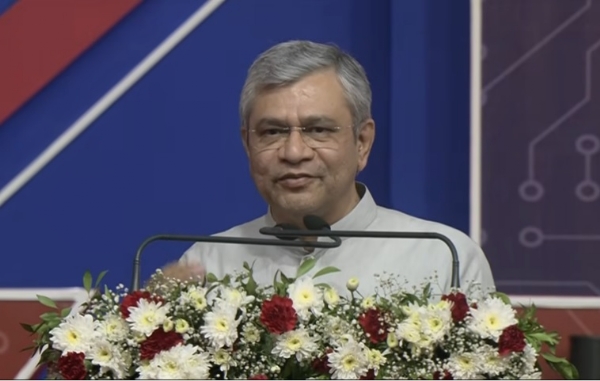
Union Minister for Electronics and Information Technology Ashwini Vaishnaw has said that a semiconductor plant in India was completed in just 14 months, from foundation to commercial production, underscoring India’s fast‑growing potential as a global hub for chip manufacturing.
Speaking at the inauguration of the Kaynes Semiconductor plant at the Sanand GIDC in Ahmedabad, he asserted that under the leadership of Prime Minister Narendra Modi, the dream of every Indian engineer is turning into reality as the country rapidly builds a credible identity in the global semiconductor landscape.
Vaishnaw described the 14‑month construction‑to‑production cycle as a direct outcome of the Prime Minister’s long‑term vision and the persistent efforts of the Gujarat state government. He stressed that this achievement marks a significant step toward India’s industrial advancement and technological self‑reliance, aligning with the broader “Make in India” and “Atmanirbhar Bharat” initiatives.
He explained that the first semiconductor plant at Sanand was inaugurated on February 28, while the second plant, run by Kaynes Semiconductor, was formally launched on March 31. The third plant is expected to be operational by July, and by 2026, four semiconductor facilities will be ready. Two more units are slated to start by 2027, he said. In addition, India’s first large‑scale semiconductor fab in Dholera, Gujarat, is projected to be ready by 2028, further consolidating the country’s position in the global chip ecosystem.
Highlighting the need for competitiveness, Vaishnaw emphasized that quality and cost competitiveness are critical for India to remain relevant at the global level. He noted that around 60,000 engineers have already been trained in advanced chip‑design tools such as Synopsys and Cadence, and that this capability is being scaled across 315 universities in the country. Indian design houses are now developing chips down to 2 nanometre nodes with global partners, reinforcing India’s shift from “assembled in India” to “Designed in India, Made in India”.
Under the Semicon 2.0 framework, the Minister said the Prime Minister has set clear directions for India to indigenously manufacture the chemicals, gases, and machinery used in semiconductor fabrication. This, he added, is essential to build a fully self‑reliant semiconductor value chain and reduce dependence on foreign suppliers.
Vaishnaw expressed confidence that by 2032, India will be counted among the top six semiconductor‑producing countries in the world, and by 2047, the centenary of India’s independence, it will rank among the top three. He concluded that the rapid progress in Sanand and other upcoming fabs signals that India is on a credible path to becoming a true global semiconductor hub.
---------------
Hindusthan Samachar / Jun Sarkar