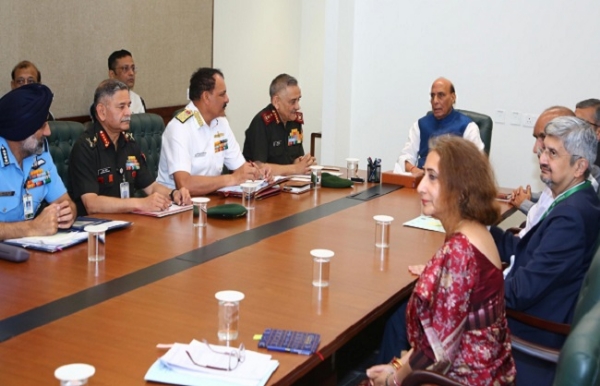
New Delhi, 24 March (H.S.):
India has warned that the ongoing war in West Asia poses a serious threat not only to its own security and economy, but also to the entire world, as global trade and energy flows face growing disruption. Defence Minister Rajnath Singh on Tuesday convened a high‑level security review with the Chief of Defence Staff and the three service chiefs, underscoring the gravity of the situation and the need for India to remain fully prepared amid escalating regional tensions.
Chairing the crucial meeting in New Delhi, Singh reviewed India’s defence readiness and the unfolding global and regional security situation against the backdrop of the West Asian war now entering its fourth week. Present at the discussion were Chief of Defence Staff General Anil Chauhan, Army Chief General Upendra Dwivedi, Navy Chief Admiral Dinesh K. Tripathi, Air Force Chief Air Chief Marshal Amar Preet Singh and Defence Research and Development Organisation (DRDO) Chairman Dr. Samir Kamat, along with other senior officials. The focus was on assessing how the conflict is affecting maritime routes, energy supplies and India’s broader strategic posture.
Rajnath Singh told the gathering that the pattern of attacks and counter‑strikes in West Asia is a matter of deep concern not just for India, but for the whole world. The Strait of Hormuz, a key energy corridor through which a large share of India’s crude oil and gas imports pass, has seen trade largely paralysed as the fighting drags on.
US‑Israel joint strikes on February 28 reportedly led to the death of Iran’s 86‑year‑old Supreme Leader Ayatollah Ali Khamenei, triggering a sharp spike in regional tensions. In response, Iran targeted Israeli and American assets across several Gulf states, further blocking maritime chokepoints and rattling global energy as well as financial markets.
Prime Minister Narendra Modi, addressing Parliament on Monday and again on Tuesday, described the evolving situation as “alarming” and warned that the conflict has created unprecedented challenges. He stressed that the war is not only affecting economic and national security, but is also taking a heavy human toll.
The Prime Minister highlighted that one of India’s largest shares of crude oil and gas requirements is met from this very region, even as the conflict has already dragged on for more than three weeks. The disruption has hit global trade routes, pushed up energy prices and weighed down on already fragile economies.
PM Modi also pointed out that large parts of the West Asian region serve as a critical trade corridor for India’s commerce with the rest of the world, making the security of these routes vital. He reiterated that the international community is urging all parties to de‑escalate and find a negotiated settlement at the earliest. India, he said, has been actively using diplomacy to secure the safe passage of merchant vessels and to press for the protection of civilian lives and essential infrastructure.
The Indian Navy has beefed up its presence in the northern Arabian Sea and near the Strait of Hormuz, providing escort to key commercial ships and standing ready to respond to any emerging threats on the high seas.
The security review in New Delhi reflects the government’s concern that the West Asia conflict could spill over into broader economic and security disruptions that would affect food, fuel and fertiliser supplies worldwide. Senior officials told the Defence Minister that India’s armed forces and defence establishments are closely monitoring the situation and are prepared to respond to any escalation that may indirectly impact Indian interests.
The government’s stance remains that prolonged conflict in the region will continue to destabilise global markets, raise the cost of living and undermine the fragile recovery of the world economy.
---------------
Hindusthan Samachar / Jun Sarkar