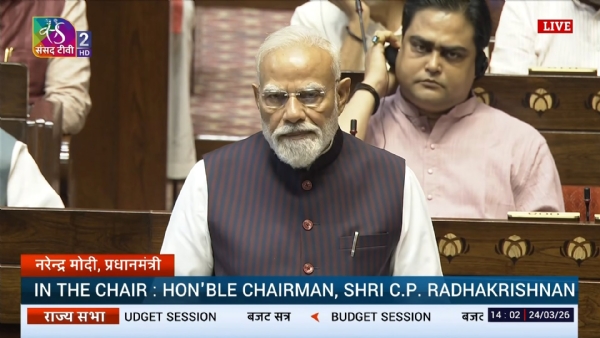
New Delhi, 24 March (H.S.):
Prime Minister Narendra Modi has told the Rajya Sabha that India is now sourcing crude oil and gas from every possible route to cope with the global energy shock triggered by the ongoing military conflict in West Asia.
Speaking on Tuesday, he said the government’s main focus is to keep domestic energy supplies flowing while simultaneously pushing for peace in the region through diplomacy, because a prolonged crisis could have serious global and economic consequences.
PM Modi noted that the war in West Asia has been going on for more than three weeks and has already affected the entire world. For India, the situation is worrying, as it is disrupting supplies of essential commodities like petrol, diesel, gas and fertilisers. Pressure has also increased on global trade routes, particularly in the Strait of Hormuz, where the blocking of ships has made the situation even more complex.
The Prime Minister explained that the administration is doing everything it can to ensure that vessels carrying fuel and other critical supplies reach Indian ports without disruption.
The Prime Minister said that nearly one crore Indians are currently living in Gulf countries, and their safety and livelihoods are the government’s top priority. Since the war began, more than 3.75 lakh Indians have been safely brought back to the country, and over 1,000 have returned from Iran, including a large number of students. At the same time, there have been some tragic incidents in which Indians have been killed or injured, and their families are being provided all possible assistance.
The Prime Minister assured that no Indian will be left behind in the conflict zone.
PM Modi stressed that India’s position is clear: the only way to resolve this crisis is through dialogue and diplomacy. He said he has held two rounds of talks with the heads of several West Asian nations and that India is maintaining continuous contact with Iran, Israel, the United States and other Gulf states at political and diplomatic levels.
India has made it clear that attacks on commercial ships and blockages of international sea lanes are unacceptable and has called for the safe and uninterrupted movement of trade through key maritime corridors.
The Prime Minister added that the government is leaving no stone unturned to ensure that tankers carrying oil, gas and fertilisers reach India safely. In recent days, several ships loaded with crude oil and LPG from multiple countries have reached Indian ports, and this effort will continue. On energy security, PM Modi pointed out that over the past decade India has expanded its energy‑import basket from 27 countries to 41. Strategic petroleum reserves of more than 53 lakh metric tonnes have been created, with additional capacity under development. He assured that India has adequate crude‑oil stocks and a robust supply‑chain structure in place.
PM Modi also said the government is working to reduce dependence on any single source of fuel. Alongside LPG, there is a push to extend piped natural gas (PNG) coverage and increase domestic production of gas and related inputs.
Emphasising self‑reliance, he remarked that India must steadily cut its external dependence in every sector. Today, more than 90 per cent of the country’s trade depends on foreign‑flagged vessels, which increases risk during crises. Keeping this in mind, the government has launched a Make in India‑backed indigenous shipbuilding programme with an outlay of around 70,000 crore rupees to build home‑grown vessels.
The Prime Minister informed the House that the government has set up an inter‑ministerial group to monitor the impact of the crisis on imports, exports, supply chains and inflation. Seven new empowered groups have also been formed to take swift decisions on petrol, diesel, gas, fertilisers and other essential sectors.
Speaking about agriculture, he said adequate availability of fertilisers is being ensured for the upcoming sowing season and farmers have been reassured that the government will stand by them in all circumstances and will not let the burden of this crisis fall on them.
PM Modi appealed to state governments for cooperation, noting that the poor, workers and migrant labourers are hit hardest when prices go up or supply chains tighten. He urged states to clamp down strictly on hoarding and
black‑marketeering and to protect the interests of vulnerable sections.
In the concluding part of his address, he warned that the West Asia crisis could drag on and its adverse effects may persist for a long time, but expressed confidence that with a strong economic foundation, coordination between the Centre and the states, and timely policy measures, India will be able to manage the challenge successfully.
---------------
Hindusthan Samachar / Jun Sarkar