New Delhi, 24 March (H.S.):
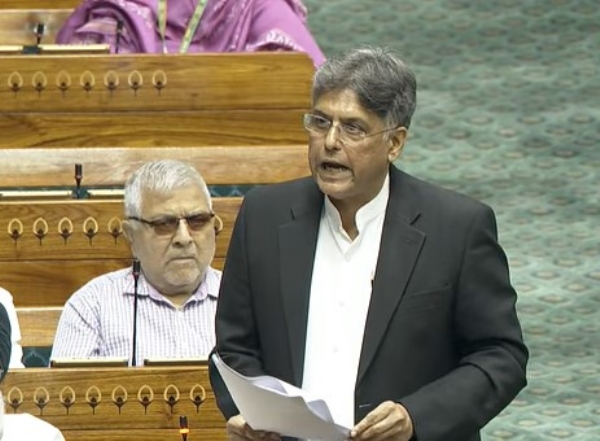
Congress MP Manish Tewari has asked the government to clearly spell out the likely fallout of the West Asian military conflict on India’s economy, warning that the current budget and fiscal assumptions are no longer valid in the face of sharply higher oil and energy prices.
Speaking in the Lok Sabha during the debate on the Finance Bill, 2026, he said the crisis in the Gulf region will expose the country to a new economic reality from May 1 onward, and the Centre must quantify the damage to sectors ranging from fuel and fertilisers to food and medicines.
Tewari pointed out that the West Asian conflict has already triggered a steep rise in global crude prices at a time when India’s dependence on imported oil and liquefied natural gas (LNG) has touched record levels. He noted that the “Indian basket” price for crude oil stood at about 70 dollars a barrel in February 2026, but shot up to over 119 dollars per barrel in March, even touching the 120‑dollar mark on certain days.
For every 10‑dollar rise in the price of crude, India’s revenue burden increases by an additional 10 to 15 billion dollars, he said, adding that the country spends between 150 and 200 billion dollars annually on crude imports.
Highlighting structural vulnerabilities, he said India’s crude import dependence has climbed from roughly 77 per cent in 2012‑13 to about 88 per cent in 2025‑26, while LNG imports have risen from nearly 29‑30 per cent in 2013‑14 to around 45‑47 per cent in 2025‑26.
Given this, the ministerial team must make a detailed statement on how the conflict will affect prices of oil, LNG, foodgrains, fertilisers and medicines, and what measures are being readied to cushion the impact on households and businesses, he argued.
Tewari recalled that the Union Budget and Finance Bill were presented on February 1, 2026, whereas US and Israeli strikes on Iran on February 28 jolted global markets and triggered a fresh wave of risk aversion. The fallout from the West Asian war is particularly sensitive for India, he said, and the basic assumptions on which the budget was built have since become outdated. He also cited rising debt levels, pointing out that total government debt stood at 56.51 lakh crore rupees in 2013‑14 and has now ballooned to 214.8 lakh crore rupees in 2026.
The combined debt‑to‑GDP ratio for the Centre and the states has reached about 84.2 per cent, far above the 60 per cent threshold set out in the Fiscal Responsibility and Budget Management (FRBM) Act.
This high borrowing, he warned, crowds out private investment and forces companies to raise money at higher interest rates, choking growth. Against this backdrop, he criticised the government’s revenue projections, noting that while the budget had assumed a 13 per cent growth in tax collections, the actual increase has been only about 3 per cent.
Corporate tax collections were expected to grow by 9 per cent, but the rise has been around 7 per cent, while personal income‑tax collections were projected to rise by 17 per cent but have climbed just 6 per cent. Indirect tax collections, meanwhile, were expected to grow by 13 per cent but have actually fallen by 1 per cent.
As tax buoyancy has weakened, Tewari said the government has been forced to borrow around 17 lakh crore rupees from the market, adding to the fiscal strain. He also questioned the effectiveness of the major corporate tax‑rate cuts announced in 2019‑20, noting that the effective corporate tax rate today is as low as 18.85 per cent. Yet private investment remains stalled and the economy has become increasingly reliant on public capital expenditure, which has now risen to about 17.14 lakh crore rupees. If the state is giving such large concessions to the corporate sector, he asked, why has private investment not picked up.
On the external front, he highlighted that the rupee has depreciated from about 60.99 per dollar in 2014 to around 93.34 per dollar now, making imports of oil, fertilisers and medicines costlier. Foreign direct investment and foreign portfolio investment have turned negative in recent months, with FDI flows in the September–December 2025 period being negative and contributing to downward pressure on the rupee.
The capital account balance stands at about minus 6 per cent of GDP and the nominal effective exchange rate has depreciated by roughly 7 per cent, he said.
Tewari concluded by urging the government to fully disclose the economic implications of the West Asian conflict, not just for the current year but across the medium term. He insisted that citizens have a right to know how much the crisis will add to the fiscal deficit, how it will affect inflation and growth, and what contingency plans the government has in place to protect the common man from the brunt of higher energy and food prices.
---------------
Hindusthan Samachar / Jun Sarkar