Lucknow,
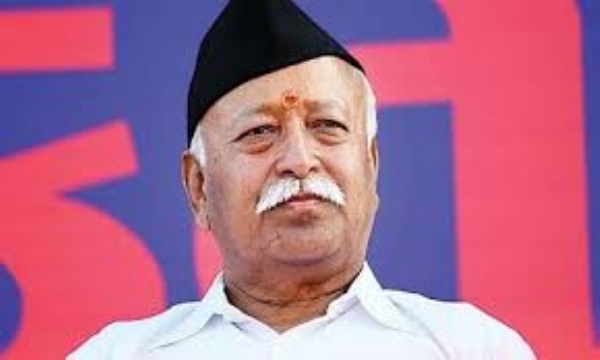
18 Feb (HS): RSS chief Mohan Bhagwat has urged on Hindu society to unite and
empower itself, stating that there is no threat but that vigilance is required,
and recommending that Hindu families have at least three children each. He also
stated that infiltrators should be found, removed, and deported.
Bhagwat
spoke at a social-harmony gathering at the Saraswati Shishu Mandir, expressing
worry over a shrinking Hindu population and calling for an end to inducement-
or coercion-based religious conversions. He also emphasized the importance of
expediting efforts to reintegrate persons into Hindu society and guaranteeing
their well-being. There is a need to unify and strengthen Hindus. The Rashtriya
Swayamsevak Sangh (RSS) chief stated that there is no threat to us, but we must
be vigilant.
Raising
worries about infiltration, Bhagwat stated that infiltrators should be
identified, removed, and deported, and should not be employed. He also stated
that Hindu families should consider having at least three children, citing
scientific research that suggests cultures with an average fertility rate of
less than three may perish in the future. Bhagwat stated that newlywed couples
should be made aware of this, and that the aim of marriage is to continue
creation rather than to satisfy one's personal wishes. He stated that a lack of
peace leads to prejudice and emphasized that all citizens have one country and
one motherland. Bhagwat described Sanatan thinking as a philosophy of harmony,
noting that discrepancies that have arisen throughout time must be resolved by
understanding and practice.
He
stated that individuals who differ should not be considered as adversaries, and
that cooperation should take precedence over fighting. The RSS chief identified
matrushakti (women's strength) as the foundation of the family, stating that
women should not be viewed as weak and should be trained in self-defense. He
stated that in Indian tradition, women are cherished and nurturing skills take
precedence above physical looks. In response to a query on University Grants
Commission (UGC) rules, Bhagwat stated that laws must be followed and that if a
law is faulty, it may be changed constitutionally. He stated that caste divides
should not be a source of strife and advocated for the empowerment of the
downtrodden by providing a sense of belonging. Bhagwat stated that India would
lead the globe in the near future and that many global problems may be solved
via the country's civilisational ethos.
He
stated that frequent community gatherings should foster social cohesion, dispel
myths, and discuss social concerns, all while providing assistance to the
weakest parts of society.
The
RSS chief warned that certain groups in the United States and China are working
against India's social peace, urging vigilance and mutual trust. The programme
was attended by representatives from the Sikh, Buddhist, and Jain communities,
as well as institutions such as Ramakrishna Mission, ISKCON, and the Art of Living
Foundation, among others.
Addressing
another session at the Saraswati Vidya Mandir's Madhav Sabhaghar, Bhagwat
stated that temples, wells, and cremation sites should be available to all
Hindus without prejudice. He believes that youngsters should be taught that a
job is about giving and helping others, not just gaining more money or
consuming more things.
The
RSS leader advised families to instill values that prioritize the country and
encourage the accumulation of knowledge and riches for the nation's sake. Emphasizing
societal harmony, he stated that efforts must begin at the individual and
family levels via increased mutual interaction, that harmony is achieved
through practice rather than rhetoric, and that caste divisions should be
eliminated from society.
Bhagwat
stated that the family, not the individual, is the fundamental unit of society,
and that social behavior is developed inside it. He emphasized the value of
mother tongue proficiency, patriotism, honesty, discipline, and family pride.
The
RSS chief advocated for reaching out to non-RSS members and for the formation
of warm social relationships that stretch from public areas to homes. He stated
that technology cannot be halted but must be utilized with discipline, such as
time limitations on viewing, and that the younger generation should be made
aware of the possible risks of excessive exposure to artificial intelligence
(AI), television, mobile phones, and films.
Hindusthan Samachar / Abhishek Awasthi