New Delhi, 08 January (H.S.):
Indian researchers have developed a groundbreaking technique to measure the local density of cold atoms in real time without disturbing their quantum states, a breakthrough with profound implications for quantum computing and sensing on Thursday.
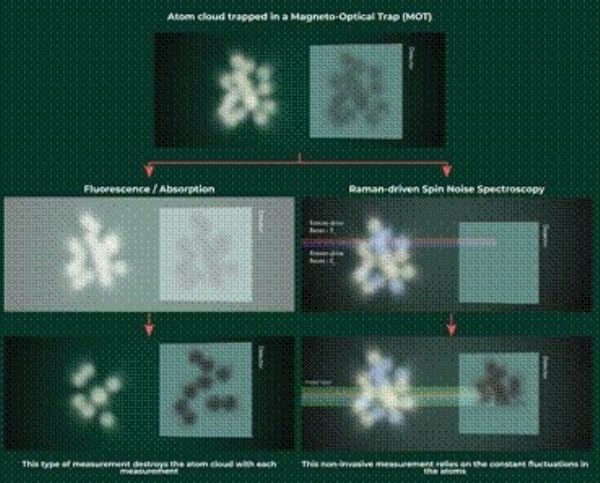
According to the Ministry of Science and Technology, traditional cold atom experiments cool atoms to near-absolute zero using laser cooling and trapping, enhancing their quantum properties. Conventional methods like absorption and fluorescence imaging falter—absorption fails in dense clouds, fluorescence is slow, and both disrupt atomic states.Raman Research Institute (RRI) scientists demonstrated Raman-Driven Spin Noise Spectroscopy (RD SNS), fusing spin noise spectroscopy with Raman beams.
Natural fluctuations in laser polarization reveal atomic spins, while two additional laser beams shuttle atoms between nearby spin states, amplifying signals by up to a million-fold.In a mere 0.01 mm³ volume containing ~10,000 potassium atoms, RD SNS enables direct local density measurement.
RRI's central density stabilized within one second, versus double the time for fluorescence-based total atom counts.Research assistants Bernadette Varsha FJ and Bhagyashree Deepak Bidwai emphasized its non-invasive nature: low-power, far-detuned probe beams achieve few-percent accuracy on microsecond timescales.
PhD scholar Sayari hailed real-time, non-destructive imaging as ideal for quantum sensing and computing, capturing subtle density fluctuations to probe many-body dynamics and validate theoretical models.RD SNS profiles matched fluorescence imaging via inverse Abel transform—yet excel in asymmetric or dynamic clouds, unhindered by axial symmetry assumptions.
Quantum technologies stand to gain immensely: rapid, precise, non-invasive density mapping enhances gravimeters, magnetometers, and sensors, enabling micron-scale local interrogation of density waves, quantum transport, and more without system perturbation.
RRI Quantum Mixtures Lab head Prof. Saptarishi Chaudhuri underscored its utility for neutral atom quantum computing, simulation, and transport studies.
---------------
Hindusthan Samachar / Jun Sarkar