Delhi, 17 January (H.S.):
A society that forgets its history not only forfeits its future but also loses its moral direction. History transcends mere chronicles of the past; it forms the bedrock of democratic institutions, public consciousness, and national character.
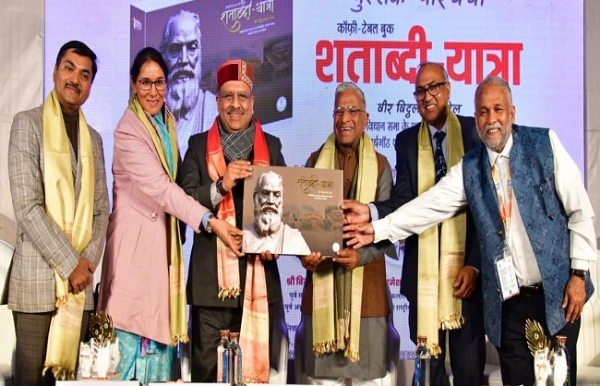
Reviving the legacy of Veer Vithalbhai Patel thus constitutes not an academic exercise but a democratic imperative. Rajya Sabha Deputy Chairman Harivansh articulated these views while addressing a seminar on Saturday at the World Book Fair, organized to release the coffee table book Shri Veer Vithalbhai ki Gaurav Gatha: Ek Shatabdi Yatra published by the Delhi Assembly Secretariat.
The event saw the presence of Delhi Assembly Speaker Vijender Gupta, former Rajya Sabha MP and ex-chairman of the Indian Council for Cultural Relations (ICCR) Vinay Sahasrabuddhe, Kalanidhi Faculty Chairman of Indira Gandhi National Centre for the Arts Rameshchandra Gaur, Professor (Dr.) Manisha Chaudhary from Delhi University's History Department, alongside academics, historians, students, and a large gathering of citizens.
Praise for Delhi Assembly's Initiative
In his address, Deputy Chairman Harivansh commended the Delhi Assembly Secretariat's efforts to resurrect a relatively overlooked chapter of the freedom struggle. He described the book as an authentic document chronicling a profoundly vibrant and pivotal era in Indian history.
Referencing the Rowlatt Act period, he highlighted that Veer Vithalbhai Patel tabled over 220 amendments in the Legislative Council and became its first Indian President. Harivansh also invoked Patel's personal integrity, his unyielding courage against colonial authority, guidance to Netaji Subhas Chandra Bose, and his bequest of his will and resources to the freedom struggle.
Pivotal Era of Freedom Movement
Delhi Assembly Speaker Vijender Gupta remarked that the period from 1912 to 1933 marked the most decisive phase of India's freedom movement, culminating with Veer Vithalbhai Patel's demise on October 22, 1933. Portraying Patel as a revolutionary, freedom fighter, and legislative leader, Gupta credited him with laying the institutional foundations of Indian parliamentary democracy. He noted that this publication aims to transcend academic confines, reaching ordinary citizens—facilitated by introducing QR codes at the event.
Former Rajya Sabha MP and ex-ICCR Chairman Vinay Sahasrabuddhe referenced Prime Minister's assertion that India is the mother of democracy, attributing to leaders like Veer Vithalbhai Patel the shaping of India's legislative and democratic consciousness. Congratulating the Assembly Speaker on the centennial journey initiative, he termed it not mere remembrance but a reintroduction of inspiration for contemporary society.
Call for Democratic Legacy Preservation
Professor (Dr.) Ramesh Chandra Gaur urged viewing the Delhi Assembly building not merely as a colonial-era structure but as a living site of democratic consciousness and national awakening. He advocated schemes like interpretation centers, museums, archives, digital repositories, and light-and-sound shows to connect youth with history.
---------------
Hindusthan Samachar / Jun Sarkar
17 Jan 2026