Kanpur,
11 Jan (HS): After the Kannauj
conversion racket was busted, the police kicked off documentation. This time,
the police took the complaint of Rambharose seriously, a resident of Nibouli,
who was trying to escape the web of religious conversion. The victim revealed
to the police the details of the accused's attempts to lure him into
conversions, including offering help. The COVID-19 pandemic had created a
crisis for people in Kanpur Dehat, from employment to livelihood. Even the
small amount of assistance received during that time was a boon. The criminals,
who had set up a vocational training center in a now-closed school a kilometer
from the Akbarpur police station, first gained people's trust by promising to
help them hone their skills and further their efforts. They also spread a web
of religious conversions, converting people from Kanpur Dehat and other places.
After the arrest of Panna Lal in the Kannauj district conversion case, the
police learned of his connections to Kanpur Dehat.
A
SIT was formed by SP Shraddha Narendra Pandey and the investigation was
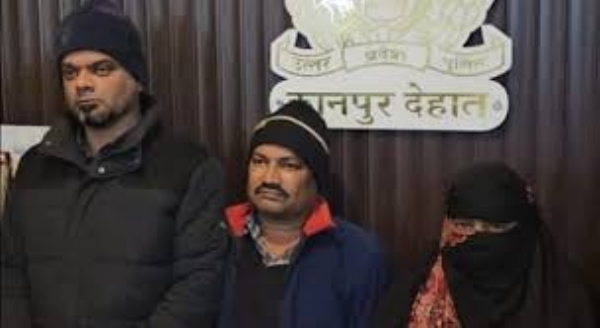
started. On Saturday, Daniel Sharad Singh, Hariom Tyagi and Savitri Sharma, who
were running Navakanti, were arrested. The SP said that earlier a school used
to run in Navakanti Society, which was closed during Covid. Later, a vocational
training centre was started here. The three people used to spread their net at
the micro and small level and trap people from Scheduled Castes and
economically weaker sections. The accused used to lure people by offering them
training in sewing, embroidery, knitting and other technical skills.
There
is a possibility of inter-district and other province connections: Besides,
they used to give people hand pumps and other small necessities. After people
fell into their trap, they used to do everything from Bible reading to
purification through the process of Baptism and then conversion. These people
have installed around 50 hand pumps in the district, which are being
investigated. The cost of installing each hand pump was around Rs. 50,000.
During the investigation, the police found many documents from the
organization's building. These are being thoroughly investigated. How many
people have the accused converted till now? An investigation is being conducted
regarding their inter-district and other province connections.
They
operated clubs based on age groups and levels: During police interrogation, the
accused revealed that they organized and operated clubs for the less educated,
youth, children, and the elderly living in villages. Two of these clubs were
the most prominent. The first was a house church. A young man who converted to
Christianity at the village level would operate a temporary church in his home,
holding prayer meetings, and influencing people by promising to free them from
poverty and highlighting the virtues of Christianity. After deceiving people,
they would convert them. The second group, Awana, specifically converted children.
Police investigations also revealed that the accused operated video Bible
reading schools, vocational centers, adult education centers, and sewing
training centers. They even declared the most mature convert to Christianity in
the district as a district-level pastor.
Learning
from the Kannauj blunder, prompt action taken: After the Kannauj conversion
racket was busted. The Kannauj crackdown prompted the police to take seriously
the complaint of Rambharose, a resident of Nibouli, who was trying to escape
the web of religious conversion. The victim detailed the alleged bribery and
conversion practices of the accused. The police, in their written
communication, spared no effort to ensure the victim's safety and take action
against the accused. In the FIR filed based on the victim's complaint, the
police invoked sections 3/5(1)/5(2)/5(3) of the Uttar Pradesh Prohibition of
Unlawful Conversion of Religion Act, 2021. According to a police officer,
Section 3 of this Act applies to fraudulently converting a woman, minor, or
Scheduled Caste person. This can result in a sentence of up to five years.
Section 5(1) refers to forced conversion. It carries a punishment of up to
three years' imprisonment. Section 5(2) deals with foreign funding for
religious conversion. It carries a maximum punishment of 14 years' imprisonment
and a fine.
They
were spreading their web like commercial activities: Just as business companies
and chit fund companies expand their business by connecting people in a chain,
they also give gifts to the concerned members when the business reaches a
certain level of profit. Similarly, members of the conversion gang used this
tactic to convert people from Scheduled Castes. First, they would deceive some
people in the name of help. After this, they would give them Rs. 200 for
attending a prayer meeting held at a designated place. Along with providing
skill training to those who propagate Christianity and induced conversions,
they would also pay them a monthly salary of Rs. six to ten thousand. After
this, they would also provide a fixed amount of money as a gift after educating
new people and getting them converted. Along with this, they would also provide
expenses for attending other programs.
Clues
were found with the help of surveillance and cyber teams: After questioning
Panna Lal, a member of the conversion gang in Kannauj, the Kanpur Dehat
surveillance and cyber team, activated by investigating the people who
contacted Panna Lal over the phone, connected the dots and reached the members
of the conversion gang in Badhapur. Police are now investigating the funding
received from within the country and abroad in the accounts of these accused.
Apart
from Kannauj, the network may be spread in the surrounding districts as well:
Police interrogation revealed that the gang members also used to go to attend
events held in the state and other provinces. Police had busted a conversion
gang in Kannauj. Cases of conversion were also reported in Mirzapur in the
month of December. Police is busy investigating whether the network of the
accused is spread in the border districts of Auraiya, Jalaun, Kanpur Nagar as
well as Fatehpur, Jhansi, Chandauli etc.
The
SIT had been gathering clues for nearly a month. The SIT team was working after
receiving input from Kannauj. Intelligence input was also gathered. This led to
the discovery of religious conversion activities taking place in Akbarpur. A
skill development academy operated in Akbarpur under the name Navakanti
Society. Police learned that Daniel Sharad Singh's original name was Sharad
Singh. After converting, the name Daniel was added to Sharad Singh.
Police
investigating links with Andhra Pradesh: After the arrest of three accused in
the conversion case, the police has started an in-depth investigation. SP Shraddha
Narendra Pandey said that Navakanti Society was earlier operating as a school.
During police investigation, some IDs have been found, which were collected by
the people of the organization. This will help in knowing how many people have
been converted till now. The records and bank accounts found during the
investigation are being investigated. This will help in finding out from where
the links are connected. SP said that the work done in Kannauj also has a link
with the district. Their organization is registered from Machilipatnam in
Andhra Pradesh, it is possible that the people associated with the organization
have bigger links, this is also being investigated thoroughly.
Foreigners
are seen in the photos obtained by the police, funding will be investigated:
Some old photos have been recovered from the records of the accused arrested in
the SIT investigation. Also, in the FIR lodged, Rambharose has alleged that the
organization is getting funding from abroad. The police is investigating this
matter thoroughly by connecting the dots. The SP said that the police have
received some photos. In some photos, 15 to 20 people and in some, 40 to 50
people are seen sitting and reading the Bible. In this, some foreign-looking
people are also seen praying. On this basis, the photos and bank accounts are
being assessed.
They
insisted on converting youth to Christianity: Rambharose told the police that
he was a farmer. Ten years ago, when he met Hariom at Navakanti Society, he
asked him to recruit unemployed youth. Gradually, many people joined the
organization, including some women, who were lured with sewing machines and
money. He said that as people began joining, Christian prayers began.
Meanwhile, people were given memory cards to listen to Christian sermons. Some
were also given radios. Two men, whose names were never revealed, would come to
the organization wearing pants and shirts. They would begin their conversations
with the greeting Jai Masih (Hail Christ) and would also say
Jai Masih (Hail Christ) when they finished. When Panna Lal of the
organization was arrested in Thathiya, Kannauj, he learned that religious
conversion is legally illegal. These people were taking advantage of people's
unemployment and financial situation to force them to convert, so he protested.
The three men threatened him, so he sought police help.
Hindusthan Samachar / Abhishek Awasthi

11 Jan 2026