By, Indrani Sarkar
The death of Anjel Chakma is not merely a tragedy. It is a question the nation must answer: how safe are students from the Northeast when they leave home to study, work, and build their futures in the rest of the country?
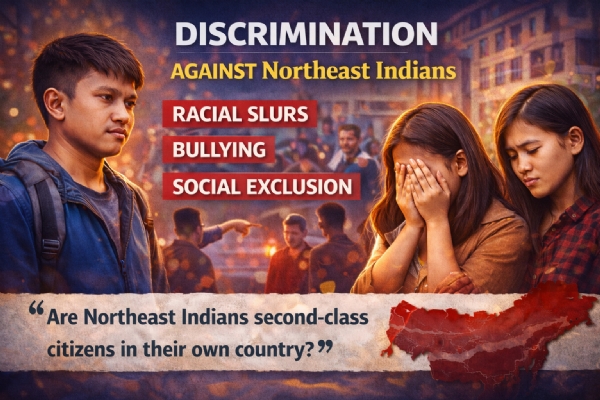
For decades, people from the Northeast have spoken of discrimination that follows them beyond their region—through stereotyping, social exclusion, verbal abuse, and institutional indifference. Students are often the most exposed. When they face hostility or distress, support systems frequently fail to respond with urgency or empathy.
This concern is not anecdotal. A government-appointed committee headed by former Home Secretary M.P. Bezbaruah documented widespread racial discrimination against people from the Northeast in metropolitan cities. Its findings showed that a significant majority of respondents reported experiencing discrimination in everyday life, including in educational spaces. The committee recommended concrete measures such as dedicated police units, fast-track legal mechanisms, helplines, and mandatory sensitisation. Many of these recommendations remain inadequately implemented. Complaints recorded by national human rights bodies over the years further indicate that discrimination against Northeast citizens, including students, is systemic rather than sporadic.
The circumstances surrounding Anjel Chakma’s death in Dehradun have sharpened these concerns. The young student was found dead under conditions that immediately raised questions about safety, institutional responsibility, and the adequacy of preventive mechanisms for students from the Northeast living away from home. As investigations continue, the case has triggered widespread outrage not only because of the loss of life, but because it reflects a familiar pattern—delayed attention, muted institutional response, and a lack of accountability when Northeast students are involved.
Anjel’s death is therefore not an isolated case. Recent incidents involving Northeast students across multiple states have repeatedly pointed to delayed institutional responses, weak grievance redressal mechanisms, and a disturbing normalisation of discrimination. Each incident may be treated as an exception, but together they reveal a pattern that cannot be ignored.
The issue is not the absence of laws, but the absence of accountability. Educational institutions are mandated to ensure student welfare, yet safety cells and anti-discrimination mechanisms often exist only on paper. Sensitisation programmes are reduced to formalities, while early warning signs and complaints go unaddressed. Coordination between institutions, host administrations, and law enforcement remains fragmented, leaving students vulnerable during crises.
This raises a fundamental policy question: if a specific group of Indian students repeatedly faces discrimination and safety failures, can the nation continue to call these incidents isolated?
Policymakers must move beyond expressions of concern to measurable action. This requires mandatory, audited student safety and grievance mechanisms in all higher education institutions; enforceable anti-discrimination protocols with penalties for non-compliance; dedicated Northeast student liaison officers in host states; and rapid-response systems that trigger immediate institutional and police coordination when distress is reported.
Above all, discrimination against citizens from the Northeast must be recognised not as a social inconvenience but as a violation of constitutional guarantees of equality and dignity.
Justice for Anjel Chakma cannot end with inquiries or statements. It must lead to reform. The safety of Northeast students is not a regional issue—it is a national test of India’s commitment to inclusion, equality, and justice.
The question before policymakers is simple and unavoidable: how many more lives must be lost before student safety is treated as a non-negotiable responsibility?
---------------
Hindusthan Samachar / Indrani Sarkar