New Delhi, 15 December (H.S.): After a brief spell of respite, air pollution levels in the national capital once again soared to alarming levels on Monday. At noon, several parts of Delhi recorded an Air Quality Index (AQI) of 500 or above, placing the city firmly in the severe category, according to real-time data from the Central Pollution Control Board (CPCB).
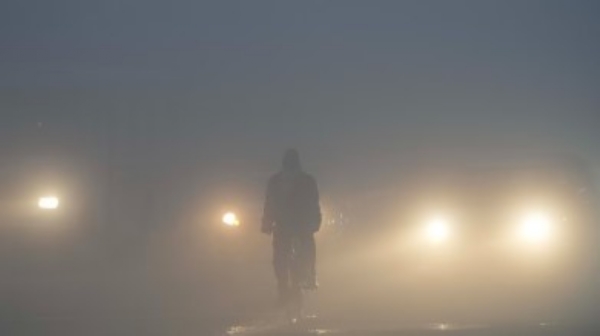
The steep rise was attributed to falling temperatures and weakened wind speeds, which prevented the dispersion of fine particulate matter in the atmosphere. A thick blanket of smog enveloped large parts of Delhi through the morning and night, significantly reducing visibility.
Around 2:30 a.m., visibility was recorded at 100 metres, which further dropped to 50 metres by 6:30 a.m. The dense fog slowed vehicular movement and disrupted traffic across major routes.Meteorologists said the northwestern winds, blowing at a speed of merely 4–6 km/hour, failed to disperse the accumulated pollutants.
As a result, air quality across nearly all city zones entered the hazardous range. Anand Vihar reported an average AQI of 490, with PM2.5 and PM10 levels touching 500. Other severely affected locations included Ashok Vihar (491), Bawana (441), Burari (452), Chandni Chowk (434), Dilshad Garden (453), ITO (454), Jahangirpuri (494), Mundka (457), Narela (455), and Rohini (500).
Sonia Vihar recorded an AQI of 463, while Wazirpur stood at 495, indicating persistently toxic air quality across the capital.
Neighbouring regions such as Noida, Greater Noida, and Ghaziabad also recorded “severe” air quality levels. In Ghaziabad, Indirapuram reported an AQI of 477, Sanjay Nagar 426, and Vasundhara 490. Noida’s Sector 125 posted 461, Sector 62 420, and Sector 116 484.
Greater Noida’s Knowledge Park V area registered 452—confirming that the entire National Capital Region (NCR) remains blanketed under thick pollution.
According to the India Meteorological Department (IMD), skies over Delhi are expected to remain mostly clear on December 15, though light to moderate fog is likely in several areas during morning hours. The maximum temperature is forecast between 24°C and 26°C, while the minimum may hover between 7°C and 9°C, slightly above normal.
Conditions are expected to remain similar on December 16, though a rise in wind speed—up to 25 km/hour in the afternoon—could bring minor relief from pollution.The Decision Support System for Air Quality Management in Delhi (DSS) reported that on December 15, vehicular emissions contributed 11.78% to the city’s total pollution load.
Industrial sources accounted for 5.96%, manufacturing 1.62%, road dust 1.62%, and household activities 2.9%, while other unidentified sources contributed nearly 32%.
---------------
Hindusthan Samachar / Jun Sarkar