Dr. Mayank Chaturvedi
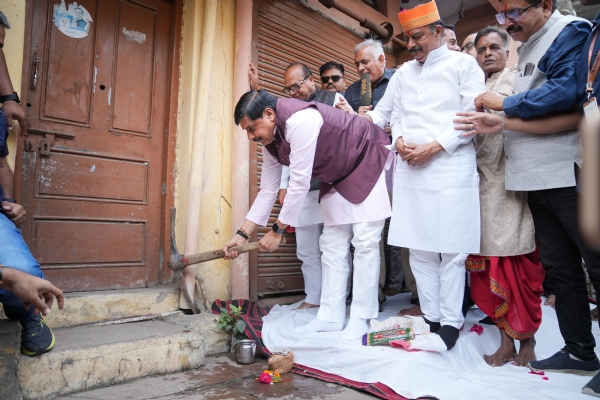
A house may be built with bricks, stones and walls, yet within it live the laughter of childhood, the memories of parents, stories of struggle and countless moments that a person carries within for a lifetime. Therefore, striking the wall of one’s ancestral home with a spade is far more than merely demolishing a structure. In essence, it also means confronting a part of one’s own memories. When Chief Minister Dr Mohan Yadav personally wielded a spade against a portion of his ancestral house in Ujjain that had come within the scope of road widening for Simhastha 2028, the scene reflected not only the necessity of development but also the conflict between public responsibility and personal emotions.
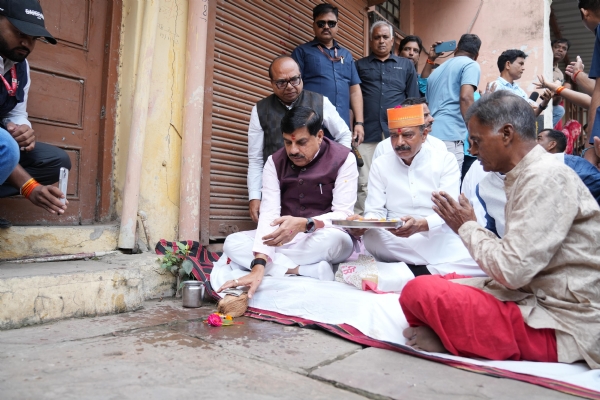
Dr Yadav spent his childhood in this very house. The house also witnessed many stages of his political journey. That is why, before the affected portion was removed, he performed a puja, entered the house and revisited his old memories. He then picked up the spade himself. The most significant aspect of the episode is precisely this: the implementation of a decision that was directly affecting the Chief Minister’s own property was initiated by the Chief Minister himself.
It is worth noting that roads in Ujjain are currently being widened in preparation for Simhastha. The work is affecting 272 buildings, including the Chief Minister’s ancestral home. In other words, the same development process for which cooperation is expected from other families has also affected the Chief Minister’s own family. It is at this point that the episode moves beyond an administrative action and enters the realm of public life. The question arises: does an elected representative place himself before the same rules in the same manner as an ordinary citizen?
Dr Yadav has presented an example through his conduct. He has also said that rules should be equal for everyone and that public representatives should set an example themselves in development works undertaken for public welfare. In a democracy, such a statement acquires greater significance when conduct is seen standing alongside it.
Sant Tulsidas, while discussing Rajdharma, linked governance with the happiness and welfare of the people. The lines from Ramcharitmanas say:
“बरषहिं जलद बिचारि बिचारी। कोपि न गरर्जहिं जलनिधि भारी॥
कृषि करहिं मानुष सब नाना। जेहि बिधि भूप धरइ निज ध्याना॥”
The essential meaning of these lines is that when the ruler’s attention remains focused on the welfare of the people, the path towards order and happiness in public life becomes easier. In today’s democracy, the ‘king’ can be understood not merely as a Chief Minister or ruler, but as every elected representative entrusted by the people with responsibility for their interests. In essence, Tulsidas’s concept of Rajdharma is not merely about the right to govern. It is also about the responsibility of conduct. That is why Tulsidas says:
“मुखिआ मुखु सो चाहिऐ खान पान कहुँ एक।
पालइ पोषइ सकल अँग तुलसी सहित बिबेक॥”
The head of an institution should be like the mouth, which receives from one place while ensuring that its benefit reaches the entire body. This couplet presents a concept of governance in which the centre of power does not work for itself, but for the whole of society. In a modern democracy, taxes are paid by the people, resources belong to the people and the ultimate purpose of development is to make their lives easier. Therefore, whenever roads, transport systems and basic infrastructure are expanded for a major public event, the convenience of citizens should remain at the centre of the process.
Simhastha 2028 represents both a major opportunity and a major challenge for Ujjain from this perspective. With the possibility of crores of devotees arriving from across India and the world, preparing the city’s transport system and infrastructure is essential. In this process, the properties of many families are being affected. In such circumstances, the Chief Minister’s own house going through the same process conveys a symbolic message: rather than placing himself in a separate category, an elected representative considers himself part of the same system as everyone else.
The road could have been altered at the Chief Minister’s signal. The locality or road where other houses belonging to Dr Mohan Yadav and his family members stand could have been excluded from the widening process. Yet he did not choose to do so. This, in essence, is the aspect of democratic leadership that conduct explains far more powerfully than speeches ever can.
Dr Yadav became emotional while wielding the spade against the wall of his own home. That was natural. Politics does not take away a person’s emotions. Even after becoming Chief Minister, a home remains a home and childhood remains childhood. The difference is that once a person enters public life, the question of public responsibility stands above personal emotions. Here, another image from Sant Tulsidas becomes relevant:
“नीर खीर बिबरन करइ हंस कहइ सब कोइ।”
The metaphor of the swan represents discernment. In governance too, discernment means keeping a clear distinction between private interest and public interest. Where there is a public necessity, decisions must take the wider interests of society into consideration.
The episode in Ujjain is significant today because it brings three dimensions together at the same time: development and displacement, emotion and responsibility, and private property and public convenience. The roads will become wider, traffic will become smoother, devotees will find easier movement during Simhastha and the city’s infrastructure will become stronger. Yet for the families whose properties are being affected in the process, this is far from an easy experience. Naturally, it is no easy moment for Dr Mohan Yadav either.
In politics, there is often much talk of sacrifice. Ideals are also frequently discussed in public life. Yet the true test of an ideal comes when its consequences reach one’s own doorstep. The tendency to have one set of rules for oneself and another for others weakens democratic trust. By contrast, applying the same rules to oneself can send a message that strengthens public confidence. The Ujjain episode needs to be viewed in this very context.
In the words of Sant Tulsidas, Rajdharma is connected with the happiness and welfare of the people. Its form has changed in the modern democratic system, but the fundamental question remains the same: how accountable is power to the people, and how convincingly does an elected representative demonstrate that responsibility through his conduct? That remains important.
In Ujjain, the spade was in the Chief Minister’s hands, but the question behind it was much larger. On one side stood the house where he had spent his childhood; on the other stood a city that has to be prepared for Simhastha. On one side were personal memories; on the other was the question of providing convenience to millions of devotees.
Dr Mohan Yadav coming forward himself to remove the affected portion of his ancestral home is, within this conflict, a public message of giving priority to the larger public interest. Certainly, the episode also presents a distinctive example of conduct as an expression of public values.
(The author is a former member of the Advisory Committee of the Central Board of Film Certification and a journalist.)
---------------
Hindusthan Samachar / Mayank Chaturvedi