Deep in the green valleys of southeastern Tibet lies Lhading, a little-known settlement associated with the historic Kongpo region and a landscape where mountains, rivers, forests and faith have shaped everyday life for generations. Far removed from the dry and stark image often associated with the Tibetan Plateau, the region presents a different side of Tibet—one marked by dense forests, fertile valleys, snow-covered peaks and a rich cultural heritage.
Lhading is also known as Nelung, a name traditionally interpreted as meaning a sacred valley. The name reflects an enduring Tibetan belief that certain landscapes are not merely geographical features but places with deep spiritual significance. Mountains, rivers, forests and valleys are often regarded as part of a sacred natural world, connecting the physical landscape with religious beliefs and community traditions.
The settlement is situated at an elevation of around 3,000 metres above sea level. Its location in southeastern Tibet gives it a climate and landscape that differ considerably from the drier areas of central Tibet. Moisture brought by the Indian monsoon supports extensive forests and fertile valleys, while the surrounding mountains remain covered with snow at higher elevations.
A river flowing through the area has played an important role in shaping local settlement and livelihoods. The river provides water for communities and agriculture before eventually joining the Yarlung Tsangpo, one of the major rivers of the Himalayan region. The river system has helped sustain farming and pastoral activities while also influencing the development of settlements across the valley.
The surrounding environment is among the most ecologically diverse parts of the Himalayan region. Forests in the area provide habitat for red pandas, Himalayan black bears, musk deer, Tibetan macaques and, at higher elevations, snow leopards. Rhododendrons, firs, spruces and oaks are also found across the landscape. This combination of forests, alpine meadows, rivers and high mountains gives the region an ecological character distinct from much of the Tibetan Plateau.
Lhading's historical identity is closely linked to the Kongpo region, an important cultural area of southeastern Tibet. The region came under the Tibetan Empire during the seventh century, a period that saw the expansion of Tibetan political influence, administration, Buddhism and trade. Its fertile valleys supported agriculture, while mountain routes connected the region with areas that are now part of India and southwestern China.
Over centuries, these geographical connections helped shape a culturally diverse landscape. Tibetan communities have maintained their language, religious traditions and customs, while neighbouring Himalayan communities have also contributed to the broader cultural character of the region.
Religion remains deeply woven into everyday life. Tibetan Buddhism has traditionally played a central role in the community, while older indigenous beliefs continue to influence local customs. Mountains, rivers and forests are often regarded with reverence, and sacred sites are associated with protective spiritual forces. Prayer flags, incense offerings and stone carvings bearing Buddhist prayers remain visible reminders of this connection between faith and landscape.
The region's cultural identity is also preserved through language, festivals and traditional practices. The local Tibetan speech reflects the heritage of the Kongpo area, while the classical form of the language continues to be important in religious texts and ceremonies. Festivals bring communities together through prayer, family gatherings, traditional music and dance.
The Tibetan New Year is among the most important celebrations, marked by religious observances and family gatherings. Another major Buddhist festival commemorates important events in the life of the Buddha. Spring also brings celebrations associated with the flowering of peach orchards, transforming parts of the region into a landscape of colour and attracting visitors interested in its natural beauty.
For local communities, however, life remains closely connected to the land. Agriculture continues to be an important source of livelihood, with crops such as barley, wheat, buckwheat, potatoes and maize cultivated in the fertile valleys. Fruit trees, including apple and walnut, along with medicinal plants, also contribute to the rural economy.
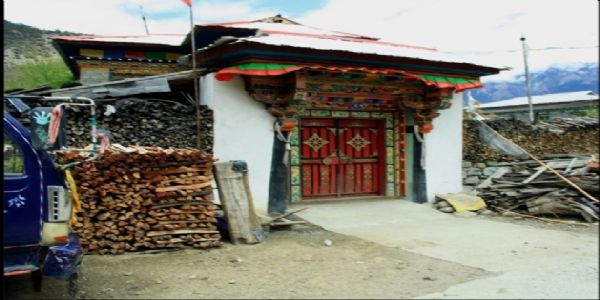
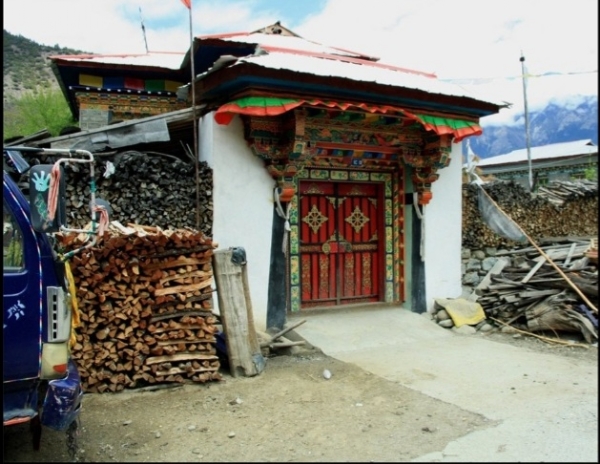
Traditional houses reflect the region's environment and craftsmanship. Stone and timber are commonly used in construction, while carved wooden windows and other decorative features provide homes with a distinctive local character. Prayer flags placed around houses and along mountain paths add another visible connection between everyday life and religious tradition.
What makes Lhading significant is not simply its location or natural beauty, but the relationship between its people and their surroundings. Here, the landscape is closely tied to memory, faith, agriculture and community life. Mountains are more than physical barriers, rivers are more than sources of water, and forests are more than natural resources. Each forms part of a cultural landscape shaped by generations of belief and tradition.
Today, Lhading stands as an example of the enduring cultural and natural heritage of southeastern Tibet. Its green valleys, Himalayan biodiversity, agricultural traditions and religious practices offer a glimpse into a form of Tibetan life shaped as much by the environment as by history.
For a region often viewed through the image of barren high-altitude plains, Lhading presents a strikingly different picture. It is a landscape of forests and rivers, villages and farms, mountains and monasteries, a place where nature and culture remain deeply intertwined.
Hindusthan Samachar / Satya Prakash Singh