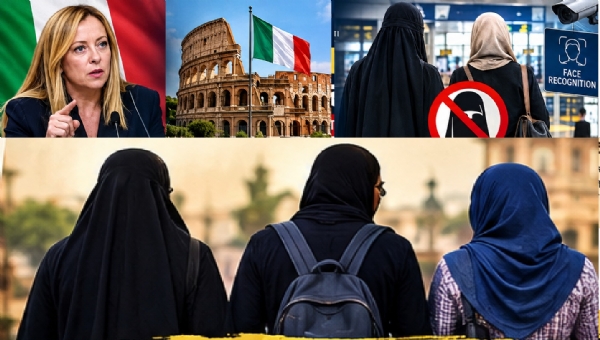
The announcement by Italian Prime Minister Giorgia Meloni regarding a ban on the burqa and hijab in schools, along with limits on the number of foreign students in each classroom, has once again brought the issue of the burqa and hijab into the global spotlight. Governments in several countries have, in fact, increasingly recognised the challenges that these two forms of Islamic dress can pose to national security and public identification systems. Modern security arrangements at airports, railway stations, government banks and sensitive buildings rely heavily on CCTV cameras and facial-recognition technology, and face coverings can make such identification considerably more difficult.
When the face is completely covered, as with certain forms of the burqa or niqab, verifying an individual's identity becomes difficult. Sri Lanka and several African countries have reported concerns that extremists and suicide attackers may exploit full-face coverings to conceal their identities and facilitate the movement of weapons. From a security perspective, law-enforcement agencies in such countries have therefore argued for requirements that allow individuals' faces to be visible in certain public settings.
There is also another dimension to the debate. Western countries, particularly European nations, place considerable emphasis on the integration of migrants into multicultural societies. Human interaction and social engagement depend heavily on facial expressions and visual cues. When the face is covered, some argue, an invisible barrier can emerge in interpersonal communication, potentially creating a sense of separation between migrants and local citizens.
According to Italian Prime Minister Giorgia Meloni, genuine integration means that migrants should learn the language of the country and respect its social fabric. The burqa, in this context, is viewed by its critics as a symbol of cultural separation that may prevent a community from becoming fully integrated into mainstream society.
In France, the principle of laïcité, or strict secularism, has long been a defining feature of public life. Under this framework, the display of conspicuous religious symbols in state institutions and schools is restricted. The broader objective is to ensure that the public sphere remains religiously neutral. At the same time, a significant section of liberal and feminist thinkers regards the burqa and niqab as symbols of patriarchal control and the suppression of women.
Governments supporting such restrictions argue that some young girls and women may be compelled by their families or religious guardians to cover their faces against their wishes. Countries that have introduced restrictions therefore maintain that such laws can protect women who do not wish to wear such coverings voluntarily. France became the first European country to impose a comprehensive ban on the burqa and niqab in public places in 2011. Belgium followed a similar path soon afterwards.
Switzerland has prohibited full-face coverings in public places across the country since 1 January 2025, while Portugal's parliament approved similar legislation in August 2026. In addition, partial restrictions are in place in countries including Austria, Denmark, Bulgaria and the Netherlands. The debate is not confined to European countries. Tajikistan, Uzbekistan, Kazakhstan and Kyrgyzstan, for instance, have also introduced strict rules concerning the hijab and burqa in schools and public spaces, citing concerns about religious extremism and the protection of their secular national cultures.
Another aspect of the issue deserves attention. Data from the research organisation Fondazione ISMU indicate that approximately 11.6 per cent of all pupils enrolled in Italian schools do not hold Italian citizenship, meaning that roughly 12 out of every 100 pupils are foreign nationals. Against the backdrop of this demographic change, the Meloni government is seeking to restrict face coverings in schools and establish a limit on the number of foreign pupils in individual classrooms. The stated objective is to prevent Italian children from feeling like a minority in their own classrooms while enabling migrant children to learn the Italian language and culture more rapidly.
Viewed more closely, the broader direction of European migration policy suggests that Italy and other European countries may pursue increasingly stringent and legally binding measures aimed at integrating migrants into their societies. Such measures could extend from rules concerning dress to requirements relating to language acquisition and participation in civic life. For the time being, the Italian government sees its approach as serving what it regards as Italy's national interests. Prime Minister Giorgia Meloni has adopted a firm position on the question of the burqa and hijab.
India, meanwhile, represents a different social and constitutional context. Here, questions surrounding the burqa and hijab have increasingly become linked to debates over community identity, with disputes extending even to schools and colleges in the name of equality, individual rights and constitutional freedoms. Matters are repeatedly taken to the courts, with competing arguments being advanced regarding law, fundamental rights and constitutional principles.
Muslims constitute a minority in India, yet the debate over the hijab and burqa is often framed primarily in terms of community identity. Critics of this approach point to the fact that several Muslim-majority countries have themselves imposed restrictions on forms of religious dress in schools and public spaces, citing security, secularism or other public-policy considerations. The wider question, therefore, is not merely about a particular item of clothing. It concerns how modern societies balance individual religious expression with public security, equality, social integration and the principles governing shared public spaces.
The debate now emerging from Italy is therefore likely to remain significant well beyond its immediate domestic context. It raises a larger question for democratic societies across the world: where should the balance be drawn between individual freedom, religious expression, public security and the need for social integration?
---------------
Hindusthan Samachar / Mayank Chaturvedi