Jammu, 12 September (H.S.): There was a time when evenings belonged to us-to open skies, dusty feet, and games that needed nothing but each other.
Sitting quietly today, I found myself thinking-when did our childhood change so much?
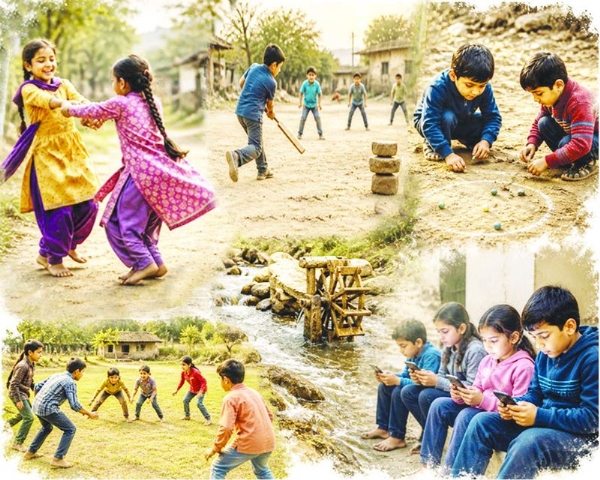
There was a time, not too long ago, when growing up in the Duggar region of Jammu and Kashmir meant something very different. Evenings were never silent. The moment school ended, children would rush outside-not because they were told to, but because something inside them pulled them there. Streets, fields, and courtyards would come alive with dust rising under running feet, laughter echoing through narrow lanes, and someone always calling out for one last round before it got dark.
Games like Kikli, Gitte, Santaliya, Gulli-Danda, Kodi-Kodi, Vish-Amrit, Stapu, and Bante were a part of everyday life. We didn't need much-just a few stones, a stick, a chalk line, or sometimes nothing at all. And yet, it felt like everything.
There was always something to play-the thrill of running breathlessly in Shu-Shapai, the careful timing in Rasa-Trapana, the quiet focus while aiming a marble in Bante, or the laughter-filled guessing in Kokla-Chapaki. Each game had its own rhythm, its own excitement, its own way of bringing everyone together.
We never thought of them as learning, yet somehow, they shaped us in ways we understand only now. Kikli taught us trust-holding on tightly, knowing the other wouldn't let go. Santaliya taught us teamwork and the joy of winning together. Gulli-Danda tested our patience, our aim, and sometimes even our temper. Khinua-Kheed, with its handmade balls, reminded us that play didn't come from things-it came from us. Somehow, those small, simple moments stayed with us longer than we ever realised. No one told us what we were learning. No one needed to.
But today, as I look around, things feel different. Children are still playing-but mostly on screens. Their world has become smaller, quieter, and somehow more distant. The lanes that once echoed with laughter now seem still. The familiar calls of just one last game have slowly faded away.
We often call this progress. And yes, technology has made life easier in many ways. But somewhere, we have lost something we didn't even realise was so precious-not just games, but a way of growing up, a way of belonging, a way of being together.
Those traditional games asked for nothing-no money, no devices, no instructions. Just time, space, and people. And in return, they gave us something that stayed-memories, friendships, and lessons that never felt like lessons. Today, when we speak of experiential learning and holistic development, as also emphasized in the National Education Policy (2020), I can't help but feel-we had it all along.
Maybe the answer is not to go backwards, but to hold on to what still remains-to let children step outside again, to let them run, fall, argue, laugh, and play together.
Because once these games disappear completely, they won't come back easily.
If we don't pause now, we may soon reach a time when these games exist only in stories-not in lived memories.
One day, our children may know every game on a screen-but none that ever touched the soil.
And when the last game fades from Duggar's fields, it won't just be silence we inherit-it will be a childhood we failed to protect.
---------------
Hindusthan Samachar / Krishan Kumar