Kathmandu, 31 August (H.S.):
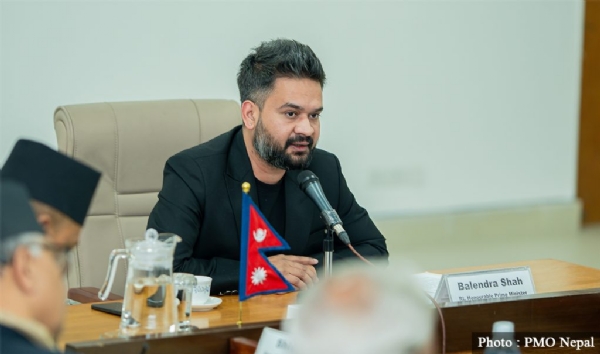
At least 781 people have died in floods in Nepal, while 9,435 people have been safely evacuated, Prime Minister Balendra Shah said on Sunday as he provided a detailed account of the ongoing relief, rescue and rehabilitation operations following five days of severe natural disasters across the country.
Prime Minister Shah said it remains challenging to ascertain the full extent of the loss of life, property and infrastructure caused by the devastating flooding of the Bhotekoshi River in Rasuwa. Despite adverse weather, difficult geographical conditions and continuing risks, the government is working on a war footing to save lives and provide assistance to those affected.
According to Shah, 9,435 people have so far been evacuated to safer locations by air and road. A total of 394 flights have been operated for relief and rescue operations, including 72 flights on Sunday. As many as 20,618 personnel from the Nepal Army, Nepal Police and Armed Police Force have been deployed in the affected areas.
A total of 279 people have been evacuated from hydropower project sites using Nepal Army helicopters. With assistance from an Indian team of experts, 250 people were rescued from areas around the Upper Trishuli-1 hydropower project in Rasuwa over a period of two days.
Besides India, Chinese and South Korean expert teams are working alongside the Nepal Army in the rescue operations. The Indian team is conducting searches inside a tunnel extending nearly three kilometres.
Rescue efforts are also continuing inside the tunnel of the Upper Trishuli-3A hydropower project in Nuwakot. Engineers from the Nepal Army are attempting to clear a passage using controlled blasting. A joint team of 90 personnel, comprising Nepal Army personnel, trained dogs from the Armed Police Force and specialists from the Nepal Police, has been deployed at the site.
A two-by-three-foot opening was created inside the tunnel, but no response was received from within. Authorities have therefore continued work simultaneously using heavy equipment, controlled blasting and tunnel-expansion techniques to gain access.
Rescue operations are also underway at the Upper Trishuli-3B, Chilime, Langtang Khola and Mailung Khola hydropower projects. Indian expert teams are coordinating with the Nepal Army in these operations.
A total of 267 injured people have so far been evacuated from flood-hit areas and taken to local hospitals as well as various hospitals in Kathmandu for treatment. Of these, 156 have already been discharged.
Medical teams from Kathmandu have also been dispatched to affected areas to provide healthcare services and psychological counselling to survivors of the disaster.
Prime Minister Shah said financial assistance is being mobilised through the Prime Minister's Disaster Relief Fund and the Prime Minister's Relief Fund. By Sunday afternoon, a total of 5.247 billion Nepalese rupees had been deposited into accounts maintained at nine commercial banks.
In addition, around US$2.1 million had been deposited into accounts at Himalayan Bank and Laxmi Bank.
Twenty-six temporary shelters and relief distribution centres are currently operating in Rasuwa and Nuwakot. On Sunday alone, these centres provided temporary shelter and relief supplies to 3,454 people.
Relief materials are being received from India, China and several other countries. India has so far provided 68.5 tonnes of humanitarian assistance and essential medicines in four phases.
India has also sent a 230-foot-long single-lane modular steel bridge and has committed to providing seven additional Bailey bridges. Nepal has requested a total of 30 Bailey bridges to support connectivity and relief operations in the disaster-hit areas.
The Asian Development Bank has pledged a $5 million budgetary grant and $150,000 in technical assistance. The World Bank has assured $167 million in concessional financing, while the United States has pledged $500,000 and Australia $1 million in assistance.
Switzerland has also provided one million Swiss francs to be spent through the United Nations for relief and recovery efforts.
The floods affected 38 Nepal Telecom towers and 27 Ncell towers. So far, 106 Nepal Telecom towers and 75 Ncell towers have been restored and brought back into operation. Twenty satellite phones have also been dispatched to areas affected by the disaster to help maintain communication.
According to the prime minister, the bodies of 781 people have so far been recovered from the flood-hit areas. The Nepal Army, Nepal Police and Armed Police Force are assisting with the management and identification of the deceased.
Bodies that have been identified are being handed over to their families. In cases involving unidentified bodies, evidence that could assist with identification, including DNA samples, is being preserved and the remains are being handled in accordance with legal procedures.
Prime Minister Shah said the government stands with every affected citizen as their guardian during the crisis. He expressed confidence that Nepal would overcome the disaster through unity and collective efforts.
He further assured that relief operations would continue to reach affected people and that reconstruction and rehabilitation efforts would remain underway until the recovery process is brought to its final outcome.
---------------
Hindusthan Samachar / Jun Sarkar

18 Aug 2026